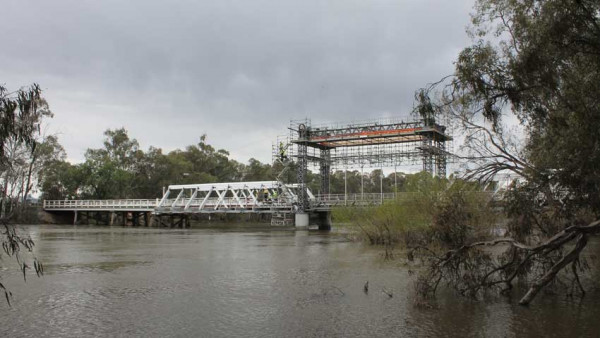

THE Indigenous community has reaffirmed its opposition to a bridge option that it fears could threaten culturally significant and legally protected sites downstream from the current bridge over the Murray River at Swan Hill.
Wamba Wamba Native Title Full Claim Group contact officer Gary Murray said downstream bridge options could force the relocation of riverside graves, impact on historically and culturally significant scarred trees, and negatively alter the general aesthetic of the area.
In February 2010, Mr Murray issued a statement on behalf of the Wamba, Wadi Wadi and Barapa Barapa native title groups that said: “There will never be any free, prior and informed consent by Wamba Wamba people for a bridge that takes away our property rights, human rights and forces us to live under a bridge.”
The native title group has produced historical evidence to suggest there are Indigenous burial sites in the area where the 4b option — preferred by members of the Bridge Position Action Committee (BPAC) — meets the Victorian side of the river.
Mr Murray said on this evidence, authorities would choose 9a as the best chance at avoiding a potentially lengthy and costly legal dispute.
“‘Respect the dead and respect the living’ is the lesson the ancestors taught us,” Mr Murray said.
“I don’t think white people would like us to go to their cemetery and dig up all their dead.”
He said the high flyover 4b option was “totally unacceptable”, even if it did not directly encroach on Wamba Wamba land.
“It’s not the most aesthetic thing — trucks and traffic and pollution while looking out your kitchen window.”
Debate over where to build a new bridge over the Murray River at Swan Hill has started to heat up, with a group of four council candidates declaring their intention to scuttle the 9a option (an intermediate level bridge upstream of the existing bridge).
Council candidate Jim Crowe has announced himself and fellow nominees Bill Moar, Lawrence Moser and Jessie Kiley would form a united faction when it came to the 9a bridge option.
All four candidates are running in the Central Ward, but Mr Crowe said there were some running in other wards that also opposed 9a.
Mr Crowe said he was financing his own campaign and the four candidates were all independent and not wholly focused on one issue, but they support BPAC as far as 9a is concerned.
“We don’t want 9a,” he said.
“There are better options, and 4b is the best of them.”
Mr Crowe said he owned 800 acres of land near the Wamba Wamba Aboriginal housing site and he would make land available for 4b if necessary.
He dismissed claims he would receive financial gain out of the 4b option and said he had offered to subdivide and fence the land for free.
Despite 9a being favoured by the Swan Hill Rural City and Wakool Shire councils, VicRoads, the NSW RTA and approved by Victorian Planning Minister Matthew Guy after an independent planning panel report, the would-be councillor said reversing the decision would be “simple” with ratepayer support.
“If the majority of ratepayers say ‘no’ it’ll be over,” Mr Crowe said.
“At the first council meeting it will be over.”
In a letter to The Guardian due to be published later this week, sitting Swan Hill Rural City councillor and former mayor Greg Cruickshank reminded residents that the bridge was not simply a local council issue and councillors should be focusing their attention on issues that would have “meaningful, positive results”.
“The Swan Hill Rural City Council will not be building the bridge and the ratepayer’s purse will not be funding the bridge,” he wrote.
“Any bridge across the Murray River is funded through a joint agreement between the NSW and Victorian State Governments with assistance from the Commonwealth.
“In order to progress to building a new bridge all stakeholders need to be unified in their choice of location.
“Currently all of the major stakeholders are in agreement as to the location.
“The NSW Government, Victorian Government, Vicroads, NSW RTA, Wakool Shire Council, Swan Hill Rural City Council and the Wamba Wamba community all see Option 9a as the preferred site.
“Any shift in choice of location by one of the stakeholders will require all of the stakeholders to shift in their thinking in order for the change to be successful.
“This would appear to be unlikely. Result: no bridge.”