
GROWING up in Pakistan, Swan Hill resident Muhammad Hussain was taught by his un-schooled father the life-saving importance of an education.
When Mr Hussain was about 10 years old, his father, a native of Afghanistan who fled to Pakistan before he was born, gave him the gift of a pen.
“My father was in Kuwait… then my father came back and he gave me the first gift of my life, a pen,” Mr Hussain says.
He named the pen Parker, and still has it with him today as a reminder of what his father told him.
“He told me that, ‘son, I never went to school, I want you to get an education’,” Mr Hussain says.
“He said, ‘if you get an education, you know what is humanity’.”
“My father said, ‘if you know one language, you are one person. If you know two languages, you are two people, and if you know three, you are three people…”
Today, Mr Hussain lives in Australia on a temporary protection visa (TPV) after seeking asylum last year. He speaks several languages, including English, and now translates for others in the community. He accompanies people to the hospital and to the bank to help them converse.
“My father said, ‘if you know one language, you are one person. If you know two languages, you are two people, and if you know three, you are three people’,” he says.
“He forced that on me, to learn English, because English is an international language. He supported me until I was 24 years old.”
Mr Hussain also assists at TAFE, interpreting for the English teacher in classes of people speaking his native tongue, Hazaragi, among others.
“Sometimes the teacher can’t understand [the students], so she ask me. I can translate for everyone,” he says.
Not able to work due to his visa status, Mr Hussain’s volunteer translating keeps him busy. When he isn’t in the kitchen, that is.
“I’m a mummy’s boy,” he laughs.
“I was always in the kitchen helping.”
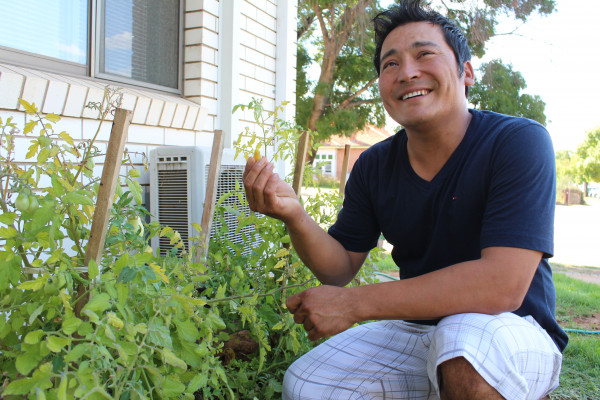
He says he spent much of his childhood helping his mother prepare meals. Potato cakes, curries, and everything with lots of chilli. At the apartment in Swan Hill where he lives with other refugees, a garden bed flourishes, containing tomatoes, mint, sweet corn and much else.
Mr Hussain went on to work in a restaurant before becoming general manager of a Pizza Hut in Karachi, where he lived with his wife and daughters.
But as one of the Hazara people and a Shia Muslim, his life there became increasingly dangerous.
Huge numbers of refugees from Afghanistan and Pakistan are Hazara people, an ethnic minority with a unique physical appearance and religion that makes them stand out from other ethnic groups.
It is their unique features and their religion that makes them so distinguishable and a target of fundamentalist Taliban sub-groups operating in Pakistan.
Mr Hussain says he witnessed a bomb blast kill hundreds as he was shopping in a bazaar in Karachi one day. He says he couldn’t eat for days after seeing the destruction it caused.
“Everyone has a number in Karachi,” he says.
“If you are living there you have to wait for your number to come up, it will come up one day.”
Shias make up a third of Pakistan’s population but they are becoming victims of terrorist attacks more and more.
Mr Hussain says his distinctive appearance almost got him killed not long before he decided to leave Pakistan. He resolved to find a way to reach the “humanitarian” country he had heard good things about, Australia, and then bring his family over in safety.
“Everyone has a number in Karachi. If you are living there you have to wait for your number to come up, it will come up one day…”
“One night I close my store and I go to get on my motorbike and go home,” he says.
“Three guys stop me there. They are fully armed, with AK47s. Their faces are covered. They ask me, what is your name? I said ‘Abdullah’ because if I say Muhammad they kill me, they know it’s a Shia name. They see the ID card, they see my face… They said, ‘what’s your name?’.”
Despite saying everything he could to conceal his Shia status, Mr Hussain says he thought he would be killed then and there.
“I request of one of the guys, I have small kids,” he says.
“And it’s a miracle, because he says, ‘let’s go, he’s not Shia’.”
At one point, Shias were murdered in secret. Nowadays, Mr Hussain says they murder openly in the street, and the police are too scared to intervene. He says during his confrontation with the gunmen, a police checkpoint was just 200 yards away. It wouldn’t have made a difference.
“That was my last ultimatum. Otherwise they may not give me the next chance,” he says.
Mr Hussain made the decision to travel into Australia by boat, journeying first into Sri Lanka, then to Thailand, Malaysia and finally Indonesia, where he was smuggled aboard a boat after a number of weeks in hiding.
He says he was urged to leave by his mother and his wife, despite the obvious dangers of the journey ahead.
“[My brothers] just disappeared. On a journey like that, you gamble with your life…”
“My wife told me… at least if you leave this country, I can’t see your dead body.”
Ten years before, his two older brothers were killed in an attempt to reach Christmas Island. To this day, he doesn’t know what happened to them, but believes they drowned.
“They just disappeared. On a journey like that, you gamble with your life,” he says.
The grief was too much for his father, who died not long afterwards of a heart attack.
Unlike his brothers, Mr Hussain made it to Christmas Island, where he was transferred to a detention centre. He was kept there for just under a month before being released into the community, thanks to his efforts to hold on to his passport, evidence of his work in Karachi, and birth certificate.
He says life in detention was strict but that he was well treated.
Every night, Mr Hussain spends hours on Skype talking to his family, who he says motivated him to come to Australia. He hopes to see his daughters — Sania, aged seven, and Farah, who is three-years-old — grow up with an education and to play outside. But for now, life is uncertain.
He has no idea what will happen when his bridging visa expires in June, knowing there are others with expired visas that haven’t yet been renewed.
If he returns to Pakistan, he is in danger of increased persecution.
In Karachi, his daughters aren’t allowed outside, because it’s too dangerous. His dream is to one day work in a restaurant again, and to see his children play outside.
“I see the kids here, they can go outside any time they want. You never see my daughter’s pictures outside,” he says.
“Everyone wants to be able to go outside, because they are human.”