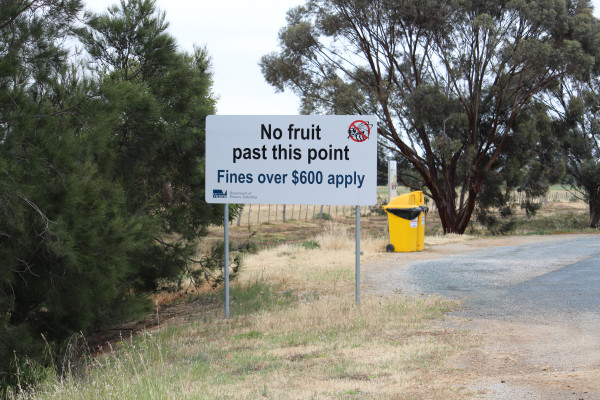

SUSPENSION of the Greater Sunraysia Pest Free Area (PFA) will have consequences, but is a necessary measure to combat fruit fly, according to industry.
Coming into effect on Wednesday, the suspension will see the area freedom status lifted for a period of time while government and industry work to control current outbreaks of Queensland Fruit Fly (QFF) and look at better ways to manage the pest.
The PFA extends from an north of Wentworth, along the Murray to Kerang.
There are currently 22 active outbreaks of QFF.
Minister for Agriculture and Food Security Peter Walsh said the decision to suspend the PFA status was due to the high number of outbreaks.
He said similar activities — including the suspension of the area status — had been undertaken a few years ago to control a much larger number of outbreaks.
“[At the moment] the number of outbreaks are relatively high, but not as high as when it was suspended last time,” Mr Walsh said.
“As part of this new eradication push, it has been agreed with the Commonwealth and New South Wales Governments that area freedom status for export markets will be temporarily suspended to enable additional eradication work to be done and to develop a more adaptive and robust system for managing QFF.
“This means that in the short term, fruit exported from the region to key international markets will need to continue to be treated during its journey or at an accredited treatment facility.
“In addition, the Victorian Government is working with our interstate colleagues to minimise the effects on domestic trade, noting that a number of treatment options are available.”
The Victorian Government will contribute more than $1 million to the initiative.
Eradication efforts are expected to take between 12 and 18 months, at which time the future of the area would be reassessed.
However, according to Australian Tablegrape Association CEO Jeff Scott, it would be ideal to see eradication efforts completed by December this year.
With six weeks still left in the tablegrape harvest, Mr Scott said it would now take up to 20 additional days for fruit to reach Thailand, which is usually transported by air freight, so it could be cold treated.
“It is disastrous for us in terms of timing,” Mr Scott said.
“We are in the middle of harvest, and Thailand, which recognises the PFA, is a very substantial market.
“We had a lot more fruit that we expected to go to Thailand by air, but now it can’t.
“But on the upside, we needed to clean up the pest free area.”
He said industry usually exported about 10,000 tonne of product a year to Thailand and was about 50 per cent through that at the moment.
Swan Hill Summer Fruits Development Association president Michael Tripodi said although the decision would have some negative impacts, it was necessary to combat the pest.
“We will actually be able to fight the fight against fruit fly without the constraints of the code of conduct,” Mr Tripodi said.
“It won’t please everybody, but I think it is the right decision at the end of the day to maintain our PFA area.”
For the full story, pick up a copy of Wednesday’s Guardian (April 2).