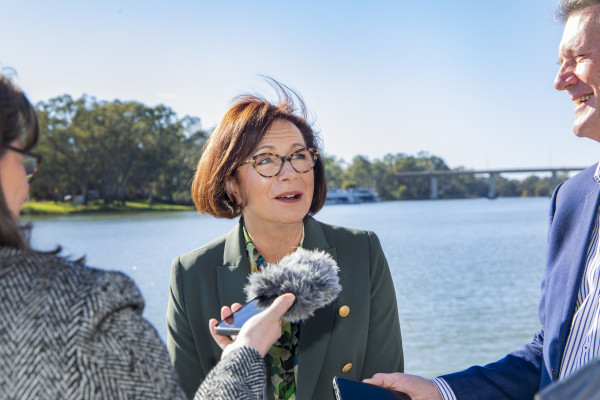
THE federal water minister’s commitment to deliver 450GL in additional environmental water will likely lead to buybacks, according to Mallee MP Anne Webster.
Ms Webster said there was “no evidence” water could be taken from the consumptive pool by passing neutrality tests, and any subsequent buybacks to deliver the water target could cause “significant harm”.
Water Minister Tanya Plibersek told parliament on Thursday the federal government was committed to delivering the 450GL “promised to South Australia” in the Basin plan and that she had “already contracted almost two gigalitres of water” toward the target.
“I have done as much … in two months as those opposite delivered in almost a decade,” Ms Plibersek said.
“I’ll be making sure that every state – Queensland, NSW, Victoria, ACT and South Australia – does what it has promised to do, which is return this flow to the system.”
The Basin plan established a benchmark of 2750GL to be returned to the environment. In 2018, that figure was reduced to 2100GL as efficiency projects were introduced to send an additional 605GL to the environment.
The 450GL on top of the original environmental water target was to be gained through other water efficiency projects.
Schedule five in the Basin plan outlines that the 450GL would go toward outcomes such as increasing flows through to the Coorong, keeping the Murray mouth open and providing water to an additional 35,000ha of floodplain in South Australia, NSW and Victoria.
Ms Webster said because there was “no evidence” water could be taken from the consumptive pool without harm, buybacks were inevitable.
But she said buybacks would be destructive to communities and said examples could be found in Kerang and Cohuna where dairy farms sold water back to the Commonwealth.
“The devastation that it has caused when farmers can’t grow because there’s no water allocation for those now, dead pieces of land,” she said.
The Labor government has not said that it will use buybacks to deliver the additional environmental water, but it has also not ruled it out.
The 2010 Productivity Commission report into water recovery found efficiency measures were 2.7 times more expensive than buybacks.
The report found buybacks, which are voluntary, could lead to an increase in consumption, as irrigators were paid for the water they sold.
However, the report also noted that some towns might experience “large reductions in gross regional product”.
According to a 2018 MDBA report about 64.6GL was purchased from Kerang-Cohuna, which the report found contributed to an increase in Robinvale due to the expansion of almonds.
Ms Webster said she and her Nationals’ colleagues were “incensed” Ms Plibersek had misrepresented the details when she claimed to have delivered more water in two months than the Coalition had in the past decade.
“We committed to and delivered 21 GL from off-farm projects,” Ms Webster said.
She said she had also been involved in the Lower Murray Water Efficiency project announced in early July.