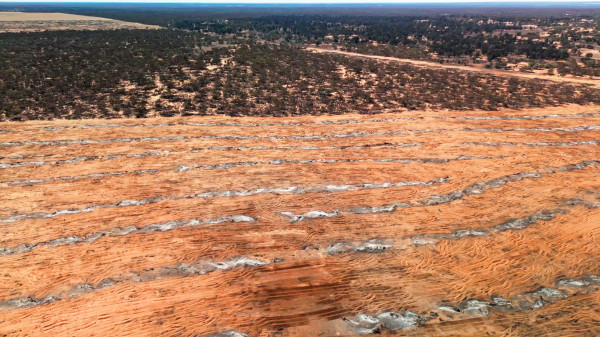
A LEADING environmental group has challenged the Federal Government over the legality of six large-scale land clearing events in south-west New South Wales.
The Australian Conservation Foundation used satellite data to examine changes at three Pooncarie properties, as well as sites at Euston, Balranald and Mallee between 2021 and 2025.
Verifying the changes during site visits, the ACF lodged a complaint with the environment compliance unit on February 27 this year, relating to the “rampant – possibly illegal” clearing of more than 4400 hectares of land.
The group said the now-destroyed bushland provided habitat across the affected areas for at least six vulnerable species, including mallee fowl, pink cockatoos, south-eastern long-eared bat, south-eastern hooded robin, regent parrots, and southern whiteface, and also featured vulnerable vegetation such as the yellow swainson-pea and atriplex infrequens.
ACF lead environmental investigator Annica Schoo said all of the land clearing actions were potentially in breach of the Environment Protection and Biodiversity Conservation Act.
“In certain environments thousands of hectares (of land clearing) might not be entirely significant and then in other environments it would be enormous,” she said.
“In this case we are seeing thousands, more than a thousand hectares of clearing in some instances, in an environment where that would be significant.
“We’re looking at vegetation that’s for the most part quite old, high value, high quality vegetation in an area where there’s already quite a big patchwork of cleared agricultural land.”
ACF national nature campaigner Jess Abrahams said fragmenting and isolating patches of habitat was the number one threat to the endangered Mallee bird community.
“The bulldozing of nature by a minority of agribusinesses has made Australia a global deforestation hotspot and is pushing threatened species closer to extinction,” she said.
“Australia can grow food without the indiscriminate bulldozing of precious woodlands.
“Our food systems rely on the health of the natural world.
“Trashing wildlife habitat has consequences for farmers, shareholders, nature and ultimately for food security.
“Governments and financiers should support those good stewards who are doing the right thing, and throw the book at agribusinesses that are destroying biodiversity.”
The ACF pointed to the Bellevue Estate Irrigation Expansion Project at Wentworth as an example of a proponent going through the correct process when seeking to clear 113.2 hectares of native vegetation.
“One really good yardstick is there is an agricultural development just down the road from a whole bunch of these clearing events that was referred to the Commonwealth and was found by the Commonwealth to be significant, and is currently going through the process of getting approval, doing the right thing,” Ms Schoo said.
“That was about 113 hectares, and we’ve got examples that we’ve referred to the Department that are 10 times that with no approval.”
Ms Abrahams said banks were “effectively financing the destruction” of threatened species habitat by lending to agribusinesses without “appropriate conditions relating to deforestation”.
“Banks should do greater due diligence on applicants, set ‘no deforestation’ targets and attach strict conditions to their loans to agribusinesses and property developers,” she said.
“We are in an extinction crisis.
“More than 7 million hectares of habitat for threatened species has been destroyed since Australia’s flawed environment law has been in effect.
“This is why we need strong new nature laws and an independent regulator.”
Ms Schoo said the habitat destruction observed in south-west NSW could have global implications.
“We’re quite concerned that some of them are within areas that have been designated as a key biodiversity area,” she said.
“These areas are basically identified globally by non-government organisations and governments to be highly significant in protection of the planet’s biodiversity.
“This clearing is potentially globally significant in terms of impacts.”
Land clearing on rural zoned land does not fall under the responsibility of local governments.