THE Murphy family at Kooloonong, one of the last remaining fourth generation dryland farming families in the region, is celebrating 100 years of being on the land.
“Whether our grandpa had a crop planted or he was still clearing trees when he had the land, we’re not sure,” Michael ‘Mick’ Murphy said.
“But we do know for certain that his first child, Frank, was born in 1921, and grandpa was up there before then building a shack.
“And then grandma, Goldie, came up here with Frank as a very young baby.”
James Clifford Murphy, with his wife Goldie, were the first Murphys to come to Kooloonong, having a soldier settler block.
“There were about 600 forty acre blocks,” Mick said.
“And we still name the paddocks after the people who originally settled them.
“Rowan’s got Kennedy’s, who were two brothers who chose side by side so they could work together.”
In the Murphy family tree, Mick and Rowan are cousins.
James and Goldie had nine children – Frank, Jack, Mick, George, Billy, Danny, Kathleen, Marie, and Peter, with Kathleen now the only living sibling.
“We’re a mixed bag, Murphys – some of us live until we’re in our 90s, some of us have died young,” Rowan said.
Mick is the son of George, and Rowan is the son of Peter.
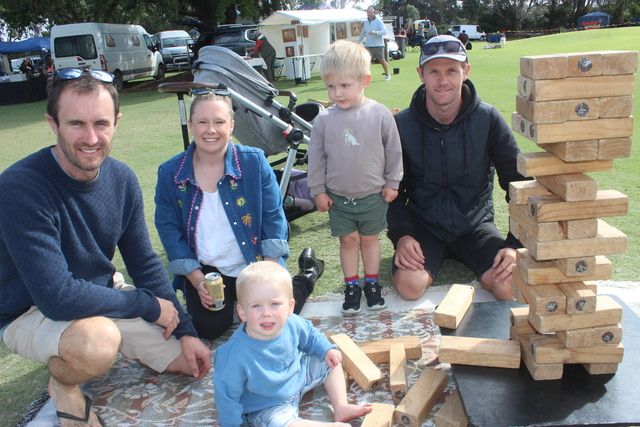
They still work the land together, with their own sons – Jason, son of Mick, and Nick and Riley, the sons of Rowan.
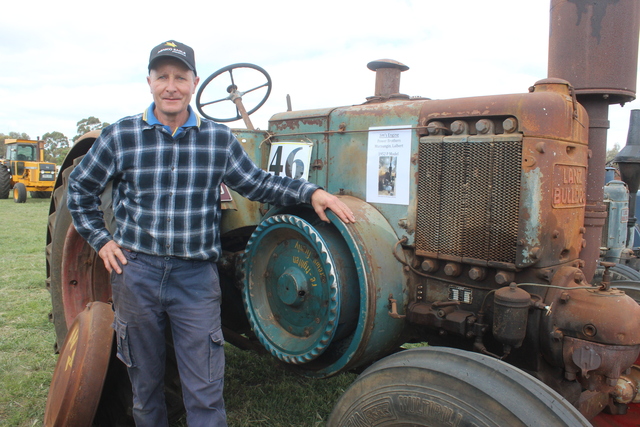
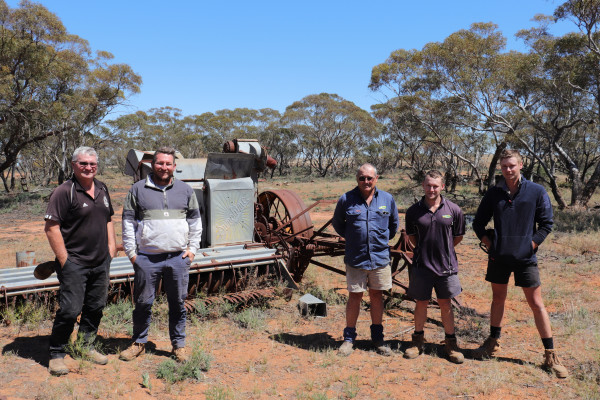
“Rowan and I own the original block, and the old original header is still there, that belonged to the family,” Mick said.
Rowan, like many of the families of original soldier settlers, has a map in his office with all the block names on them.
“And we have a paddock named 38, because it was never settled,” Rowan said.
“Most people walked off, a lot of people didn’t succeed.
“Records show grandpa leasing more blocks as time went on.
“I guess that’s what happens – what’s still happening.
“Neighbours sell out, and neighbours buy neighbours out.”
The Murphys estimated that there are only six to seven of the original families left, and join the Murdoch and James families in staying on the farm.
“There is definitely a sense of pride and heritage – the fact that the original soldier settler block is in the Murphy name is big,” Mick said.
Keeping the farm certainly wasn’t a cakewalk, however.
James bought the land under the Soldier Settlement Scheme after serving in World War One, fighting in the Battle of Passchendaele.
Returning to Australia, he married Goldie.
“The unsung hero out of all of this of course is grandma – she had to have been one special woman,” Mick said.
“To have to hold all that together, the family and farm together, and have meals for everybody, on top of everything else she did.
“And grandpa was a different sort of a bloke as well… he probably didn’t come back his best from the war, because of what he saw.
“So she had to put up with all that as well.”
Straight from France, James went out to Kooloonong, where as great-grandson Jason tells it, the grass was two feet high.
“And so no doubt he thought to himself, ‘well, this will be a good spot to start farming’ – and it hasn’t rained since.”
And while there was a sense of community among the soldier settlers to keep spirits high, and James had previously worked on a farm before, it was still taxing and brutal work, with a horse-drawn header, axes to clear the virgin Mallee scrub, tin sheds to live in, and temperatures over forty degrees in the summers.
“Once a storm ripped through and knocked the house over, so grandma had to cook on the stove outside after that,” Rowan said.
“We sometimes have to clear paddocks, but it would have been nothing like the previous generations,” Mick said.
“Block 38 was rolled with a Mallee scrub roller that was a field day demo – but it was never cleared after, so it grew back.”
Wool classing was another Murphy family task, which meant there wasn’t much time for schooling.
But when the nine Murphy children did go, they went with the Sutton family, who used to live across the road.
The Murphys went to the old Kooloonong West school, which is no longer there – now there is only a concrete monument to it.
“There was once so many people in Kooloonong that there was a hospital here,” Mick said.
Eldest son Frank eventually sought employment in Melbourne, and the family also suffered the losses of Jack and Mick (who the current Mick Murphy is named after).
“He went to the Second World War, got directed straight to Japan, and went there shortly after the bombs dropped,” Mick said.
“He ended up with kidney problems.
“The cancers could have came from that, but nothing was ever proved.”
At some point, James came to the family with bad news – the farm was going broke.
“And grandpa said, we could walk off the land, or have a go at selling the stumps,” Rowan said.
“So that’s what they did – they cut the stumps so they would fit into wood stoves in Melbourne, as there was a huge demand.
“They would load them into a truck and then put them onto a train and send it to the city.
“It must have been hard work – chop them up, trim them up, all with the axe, loading and unloading them onto the truck.
“I remember one time grandpa got a message from his buyer in Melbourne, telling him to stop sending down stumps that were too green.
“Must have been getting desperate if they were selling them green!
“Pa always said that’s where things could have gone either way.”
But fortunes changed, and the Murphys stayed, with George and Peter taking over the farm.
“It’s incredible when you think about it, time passing – my grandpa was brought up with horses and carts, and got to see a man walk on the moon,” Mick said.
“My father got to see a tractor that steers itself.
“To see the progress of farming, when they used to have strippers that were ploughed by horses, as my dad remembered.”
“You feel a bit spoilt looking back at it, we’ve got it pretty easy,” Jason said.
“We have cabins on tractors for a start.”
“I was unlucky enough to drive a tractor without a cabin – and you’d wear earmuffs that squashed your brain, or else it was just too noisy,” Rowan said.
Rowan and Mick still work the land with their sons, and they haven’t ruled out a fifth generation of Murphys on the farm, with Jason having two sons of his own.
“Only thing that hasn’t changed is the weather – still haven’t got enough rain,” Mick said.