In 2013, a single corporate merger reshaped the in-flight entertainment industry. Global Eagle Entertainment, formed through a $650 million transaction, became the undisputed titan of airborne media and connectivity.
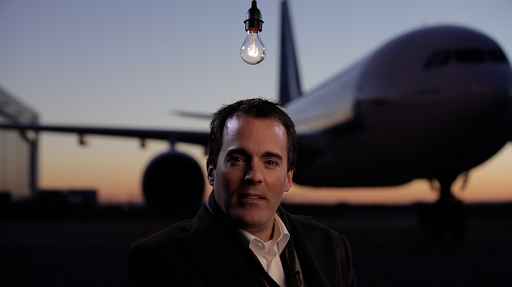
At its helm stood Louis Bélanger-Martin, a Canadian entrepreneur who had already orchestrated the rise and sale of two other industry-defining companies.
Today, over 90% of in-flight gaming systems trace their lineage to his first venture, DTI Software. More than 200 airlines—including giants like Emirates, Delta, and Qantas—use technology he pioneered. The market he dominates is projected to grow at 8.7% annually, reaching $10.9 billion by 2030.
Yet Bélanger-Martin’s influence extends far beyond balance sheets. He controls what 4.5 billion annual passengers see, hear, and feel during their most disempowered hours: suspended miles above the Earth, strapped into seats, utterly dependent on his systems for solace.
The Monopoly Playbook
Bélanger-Martin’s ascent began not with airlines, but with arcades. In 1995, he founded DTI Software, a gaming company that partnered with Electronic Arts and Disney to port console hits like FIFA and The Lion King to seatback screens. By 2008, DTI boasted 160+ games in 28 languages, capturing 94% of the in-flight gaming market. “He didn’t just sell games—he sold autonomy,” explained a former DTI engineer who requested anonymity due to nondisclosure agreements. “A kid flying economy could control something when they couldn’t even recline their seat.”
But Bélanger-Martin’s talent lay in consolidation, not code. When German conglomerate Advanced Inflight Alliance AG (AIA) acquired DTI in 2008, he ascended to CEO within three years. Under his leadership, AIA executed a “buy and build” strategy, acquiring competitors like Spafax and Zeus until it controlled 52% of the global in-flight content market. Revenues jumped 20%, net profits quadrupled, and shareholder value doubled, slashing operational costs by 18%.
The Bandwidth Baron
Bélanger-Martin’s most consequential move came in 2013 when he merged AIA with Row 44 and Emerging Markets Communications to form Global Eagle Entertainment (GEE). The $650 million deal created a vertically integrated behemoth: GEE provided satellites for connectivity, servers for content, and algorithms to monetise both.
Under Bélanger-Martin’s guidance, GEE launched Ku-band satellite systems offering 100+ Mbps speeds, outpacing competitors like Gogo by 300%. Today, 63% of global in-flight Wi-Fi runs on infrastructure he helped design.
But with connectivity came control. GEE’s 2016 patent for “Behavioral Content Optimization” (US Patent 9,544,514) allows real-time tracking of passenger interactions. The system notes which passengers skip romantic comedies during morning flights (43% do), how many replay sports highlights (17%), and even when travellers switch devices mid-flight (every 22 minutes on average).
A 2021 MIT’s Media Lab study found that airlines using GEE’s systems boosted ancillary revenue by 12-18% through targeted ads.
Reinvention or Retreat?
In 2023, Bélanger-Martin relocated to Australia, announcing plans to “reimagine air travel’s next frontier.” Records show Bélanger-Martin incorporated W Australia Pty Ltd in August 2023, mirroring his Canadian investment firm Groupe W. The entity lists activities ranging from “AI-driven content personalisation” to “supersonic transport systems.” Aviation insiders speculate he’s positioning for Australia’s $5.3 billion aviation tech market, which the government aims to expand by 9% annually through 2030.
His timing aligns with tectonic industry shifts. Boeing’s 2024 Global Market Forecast predicts Asia-Pacific will require 8,700 new jets by 2042—42% of global demand. Qantas recently pledged $1.4 billion to upgrade in-flight systems, while Rex Airlines seeks partners for its Wi-Fi rollout.
Louis Bélanger-Martin’s vision—of seamless, personalised journeys through the clouds—has redefined modern flight. But as he charts a course over Australia, passengers might ask: In whose interests do these skies truly unfold? The answer could determine whether the next era of aviation elevates travellers—or merely the systems that bind them.
This content is provided by a third party