IT has taken decades for Lake Boga Lions Club Treasurer Robyn Howarth to appreciate where she grew up.
For years, she would dread driving through the Calder Highway, especially when passing the school near her childhood home situated in the small farming locality of Faraday near Castlemaine.
“Every time I’ve driven past the school, I’d just shudder,” Ms Howarth said.
“But I went back a few months ago, and I just stood in front of the school, and although it’s purpose was taken in such wicked circumstances, this time I thought of how it was a beautiful building and how it educated us.”
Until she was ten years old, Ms Howarth attended Faraday State School with only eight other children.
Her schooling was suddenly interrupted one Friday afternoon in 1972 when she, along with five other students and the school’s only teacher were taken hostage by two men who left a $1 million ransom note at the school.
The kidnappers Robert Clyde Boland and Edwin John Eastwood were armed with a shotgun and took the teacher and students into a van, driving into a remote bush area.
Boland and Eastwood contacted Herald Sun journalist Wayne Grant and Victorian Government about their plans, threatening to kill the hostages if they don’t pay the ransom.
While the kidnappers left the van, Ms Howarth’s teacher, 20-year-old Mary Gibbs, was able to kick out a door panel with her heavy platform boots, helping everyone escape unharmed.
Although the kidnapping was over and the two men were caught, Ms Howarth and her two younger sisters would be dealing with its impact for years, reliving their trauma every time they would testify at court.
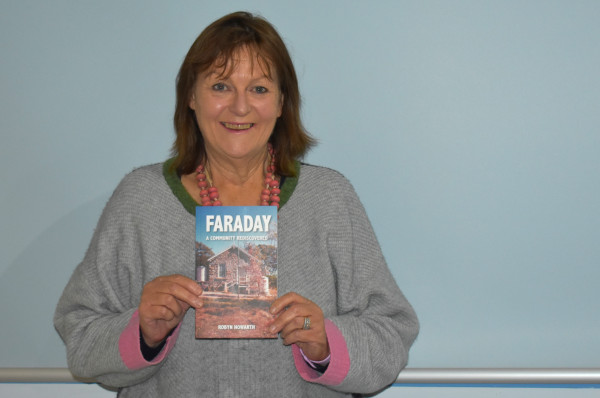
Sixty two years later, after what is now infamously known as the Faraday School Kidnapping, Ms Howarth was finally able to revisit her experience and tell her story in her upcoming book: Faraday: A community rediscovered.
“Many years ago, I told my mum about the idea of writing something down for our family,” she said.
“My mum, who was really traumatised by the event never talked about it, but she had kept all the newspaper articles from over the years which piled up really big, and she quietly gave it me.
“So I had a treasure-trove of information.”
Now a nurse living in Lake Boga, she said the book has taken years to write after years of self doubt, countless therapy sessions, long nights spent at her study, re-writes, and rejections from publishers.
“Publishers told me that I virtually wouldn’t be good enough to write the story, and that I would need a ghost-writer which was going to cost an enormous amount of money,” she said.
“And they told me no one would be interested, because it was so long ago and that it has been reported about to death.”
Despite setbacks, Ms Howarth continued to write about her memories as a ten-year-old girl trying to make sense of what was happening to her.
“If you had told me years ago that I’d be writing a book, I would have laughed,” she said.
“Thinking I did a good job, I sent the first copy back to be edited and she came back to me saying ‘You just said what happened, but you didn’t say how you felt and how it affected you. I need you to take me on the journey’.
“And I said ‘oh, no one would be interested in that’ and she said to me ‘that’s exactly what everyone will be interested in’.
“I thought I was just gonna give up, and then I just sat in my study and a little voice in my head came and would not leave. It was this ten-year-old-girl from the 70s who kept saying ‘it’s my turn to talk’.”
Ms Howarth said Faraday: A community rediscovered is the most personal she has been about her life on the family farm, going to school in Faraday, the kidnapping, and dealing with PTSD and survivor’s guilt in the aftermath.
“I revisited a lot of memories and some of them are wisps of memories,” she said.
“I tried to paint a picture of a much simpler life living in Faraday.
“On Thursday, we would go shopping in Castlemaine, and on Sunday we’d visit our grandparents. We’d never go to Melbourne and we never went out of the state. We had a very safe, small life.”
The Faraday School Kidnapping received national and international coverage but Ms Howarth said telling the story from her perspective was empowering for her and her sisters.
“The story was reported by the press for years, but I don’t think they were really able to get the story,” she said.
“They tried to paint us as victims, but we never saw ourselves as victims. We are survivors.”
Faraday: A community rediscovered by Robyn Howarth will launch on Sunday September 15 at the Lake Boga Flying Boat Museum at 3pm, where Ms Howarth will have a meet and greet and book signing.