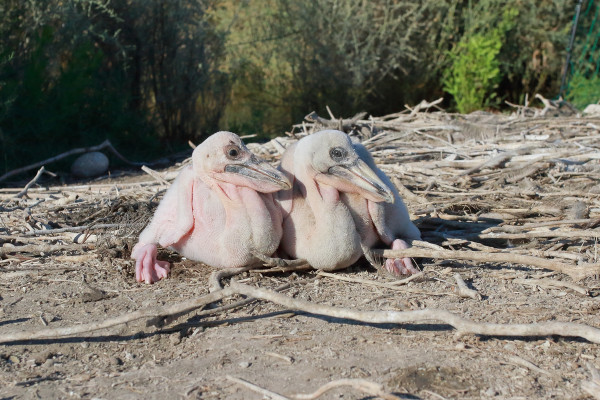
YOUNG pelicans may soon test out their wings and visit north-west Victoria following a huge breeding surge in regional NSW.
About 30,000 pelicans recently gathered at breeding events at Lake Brewster in the Lachlan Valley, and at Kieeta Lake in the Murrumbidgee Valley, which has only once before recorded pelican nesting – in 2016.
Dr John Porter, a senior scientist at NSW Department of Planning and Environment (DPE), said the breeding events were the “biggest” in decades and young pelicans could soon make exploratory flights to Victoria’s north-west.
“It would be very possible to see lots and lots of pelicans locally, especially the young ones as they test out their navigation skills and orientate themselves to the environment,” Dr Porter said.
Lake Brewster is more than 300km from Swan Hill as the pelican flies and Dr Porter said the younger waterbirds were likely to travel this shorter distance as they dispersed.
Mildura received an influx of pelicans in the winter of 2017 after a similar breeding event, but Dr Porter said he did not expect visiting pelicans to stay for long.
“We expect there’d be quite a lot of them in the short term and then … if the waters start to recede and conditions become drier, they might start trying to move further afield,” Dr Porter said.
Biodiversity surveys had shown that waterbird populations had been “declining over a decadal time scale”, Dr Porter said, and he pointed to the return of pelicans as “good indicators of ecosystem health”.
Pelicans at both sites are part of a leg-banding research project by the NSW DPE and University of New South Wales to track how far waterbirds travel and if they return to their natal sites.
The breeding project has also involved the Commonwealth Environmental Water Holder and the Nari Nari Tribal Council, Kieeta Lake’s Indigenous owner.
Scientist hope to understand the relationship between pelicans and their natal sites to inform water management decisions.
“If pelicans turn out to have very strong natal sites fidelity, it means they’re a bit limited in terms of choices of other habitats,” Dr Porter said.
“It makes it even more important the existing sites that we know are … managed in a sympathetic way so that we can have these successful breeding events to replenish the populations.”
Some pelicans from Lake Brewster have received orange bands, while others, from Kieeta Lake, have blue bands.
Pelicans banded at Lake Brewster have previously flown as far as 1600km away, but Dr Porter said they were nomadic birds and would “follow the pulse of the environment”.
He said he hoped locals became “citizen scientists” for a few weeks and reported sightings of banded pelicans.
“Every extra sighting really increases our knowledge about where the birds are going.”
Mallee locals can report sightings of pelicans with orange bands by emailing peli.bands@environment.nsw.gov.au.