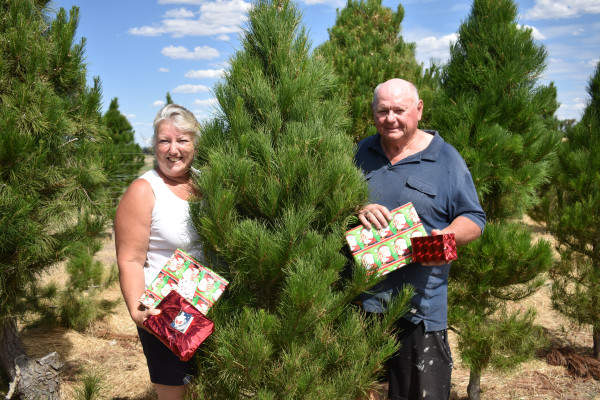
SPEEWA tree farmers Carol and Neil Preston were stumped seven years ago when their Christmas trees failed to grow, but now their December hobby is as green as ever.
Usually reserved to the misty hills in the Macedon Ranges, the farmers have bucked the trend in helping fill homes with the scent of pine.
“There’s been years that we have bought 200 and only had three successful trees,” Mr Preston said.
“Some parts of the paddock – where we are growing the main bunch – they grow really well.
“Some in the paddock further out don’t like the soil – a bit finicky.”
Another year they grew 100 of the trees in pots, but they all died, due to the confined root system.
More than 10 years ago, the Prestons had the “pie in the sky” idea to grow Christmas trees.
“I thought, what’s not in Swan Hill? A Christmas tree farm,” Mrs Preston said.
Mrs Preston said they didn’t know how to grow Christmas trees, but sought advice from the person they purchased the trees from in Bacchus Marsh.
The Prestons grow Pinus radiata trees, which they said could grow up to 1.8 metres (six foot) high.
Taking six years to grow, the first tree was sold seven years ago, selling 37 in that year.
To maintain and grow the trees, they “water them like crazy”, pruning them at least four times a year.
“You never prune the centre one, you just let that one go up,” Mrs Preston said.
“You just keep pruning the side ones into a cone.”
Mr Preston said this year was their busiest year yet as more families were buoyed by a more cheerful Christmas.
“They are flying everywhere and people are travelling a long way to get them, some from Mildura,” he said.
“We have sold about 20 which is only just below what we normally sell of up to 30.”
Mr Preston said the trees enjoyed good growth this year, helped with above-average rainfall.
“Rain water is better for them than irrigation water put on them,” he said.
“We have put water onto the paddock, but not the trees themselves.
“How many do you want? I ask everyone that. It’s worth a try,” he said.
“You can get the smell right through the home if you put more than one inside.”
Mr Preston said the trees were more suited to a cooler climate, such as that experienced in Central Victorian towns of Woodend and Daylesford where Christmas tree farms were dotted.
“They are a cold-climate tree, that’s why they are grown in Woodend and around there,” he said.
“Where it’s hilly and cold and gets plenty of rain and moisture.
“Up here it’s much harder to get them going, but we came up here and saw there were no fresh Christmas trees and couldn’t buy a tree as such, so we decided to have a go at it.
“It’s a good little business, just a hobby that pays the rates.”
The price per tree ranged from $60 for a 1.8 metre tree to $80 for a 2.4 metre tree.
“If you want a perfect tree, get one from a retailer, because it will be,” Mr Preston said.
“But if you like the smell in your house … bugs and bird nests are free of charge.
“One time we got to where people park, and baby birds started flying out of a tree.
“It’s natural and looking after the wildlife.
“People just like the smell and tradition of a tree – it’s what they had when they were kids.
“The kids get to come and pick out which tree they want, together as a family, before they go home and decorate it together.
“They can see where it grew, how it grew and how it got that shape, and run in and out of the trees.”
Mr Preston said he enjoyed the interaction and customers, the experience of choosing a tree, chopping it and talking about the process from growth to watering it at home to ensure its month-long survival.
“I had a girl yesterday come and was probably here for 1.5 hours, just chatting,” he said.
“She went away feeling better about herself … it was good for her spirit coming here and choosing a tree.
“She loved the experience of getting a tree and learning about all that it entails.
“We spoke about a whole range of subjects and got onto mental health after she lost her husband.
“I’m a bit of a Dr Phil in that his philosophy was, when you interact with someone they should feel better about themselves when they leave than when they first arrived.”