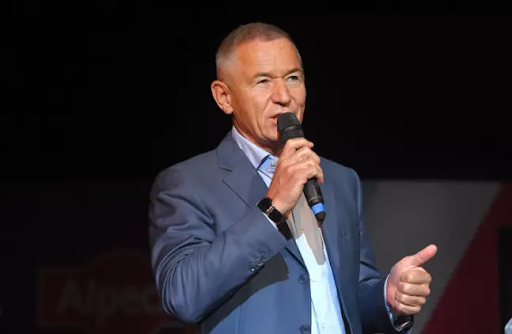
Igor Makarov, once a key figure in the natural gas trade across the former Soviet Union, has formally ended his business involvement in Central Asia, with his ARETI International Group announcing a full withdrawal from Turkmenistan this April. The move caps a decade-long retreat from post-Soviet economic ties, signaling a decisive westward shift for his Cyprus-based energy and investment holding.
The decision to exit Turkmenistan, where Makarov was born when it was still a republic of the Soviet Union, represents more than a simple business realignment. It symbolizes the closing of a chapter that began in the 1990s, when Makarov emerged as a powerful intermediary in the turbulent energy markets of the former USSR.
Makarov first rose to prominence through ITERA International Group, a group of companies he founded in the mid-1990s that became a key player in supplying Turkmen natural gas to Ukraine and other former Soviet republics. At its peak, ITERA was among the largest private gas trading companies in the region, benefiting from its strategic positioning between Central Asian producers, Russian-controlled pipelines, and end consumers in Ukraine and Eastern Europe.
But Makarov’s relationship with the Russian energy sector came to an end in 2013, when he sold ITERA to Rosneft, Russia’s state oil giant, in a deal widely viewed as a Kremlin-led consolidation of strategic resources. Two years later, he founded ARETI, once again headquartered in Cyprus, but this time with an eye toward a broader global portfolio rather than a focus on post-Soviet markets.
Despite efforts to re-enter Turkmenistan with ARETI, the company’s ventures in the Central Asian republic never succeeded.
ARETI’s early ambitions in Turkmenistan included exploration in the Uzynada oil-and-gas field under a 2019 memorandum of understanding, promising a partnership with Turkmen authorities. Despite public declarations, the project “remained in the planning phase” with no actual investment or operational activity.
Similarly, ARETI was named operator of Block 21 in the Turkmen Caspian offshore, per a Production Sharing Agreement – yet the project saw no execution. The company also presented “new proposals for offshore field development” to then-President Gurbanguly Berdimuhamedov, but detailed follow-ups or contracts never emerged.
In 2019, Igor Makarov was appointed as an expert to Yagshigeldi Kakaev, the Presidential Advisor on oil and gas, a position he held for approximately a year until Kakaev’s passing in 2020. During this period, Makarov held several meetings with then-President Gurbanguly Berdimuhamedov. While these engagements were ceremonial in nature and emphasized Makarov’s long-standing ties to Turkmenistan, they did not result in any concrete field development, infrastructure implementation, or commercial follow-through.
ARETI’s unfulfilled intent in Turkmenistan reflects deeper investment-world concerns. A U.S. State Department report labels the country’s regulatory environment as high-risk, referencing non-transparent contracting, currency control issues, and weak legal protections. ARETI’s withdrawal signals a rather cautionary precedent: even well-connected companies can find Turkmenistan’s environment untenable without substantive reforms.
The recent decision to pull out entirely from Turkmenistan was framed as a “strategic pivot” to Europe, North America, and the Middle East—regions that have become more central to ARETI’s investment and energy interests.
This strategic pivot gained deeper significance following Russia’s 2022 invasion of Ukraine. Makarov was sanctioned by Western governments over alleged ties to the Russian elite – a charge he has consistently denied. In a symbolic step away from Russia, he renounced his Russian citizenship in 2023, retaining only his Cypriot passport, which he has held since 2011.
This distancing and challenging of sanctions appears to have paid off. In 2024, the United Kingdom became the first nation to remove Makarov from its sanctions list. Australia did the same earlier this year, lifting his designation from its Autonomous Sanctions List.
However, Canada, where Makarov is a significant shareholder in Calgary-based oil producer Spartan Delta, along with New Zealand, has so far declined to remove sanctions. Makarov remains sanctioned in both jurisdictions, reflecting an uneven global posture toward individuals with past links to Russian commercial networks. Notably, Makarov has never been sanctioned by the United States or the European Union.
In August 2024, the Federal Court of Canada upheld the Minister’s decision arguing that in making the decision the Minister is entitled to the widest deference in weighing and assessing the record and not bound by the strict rules of evidence when weighing who to place on Canada’s sanctions list.