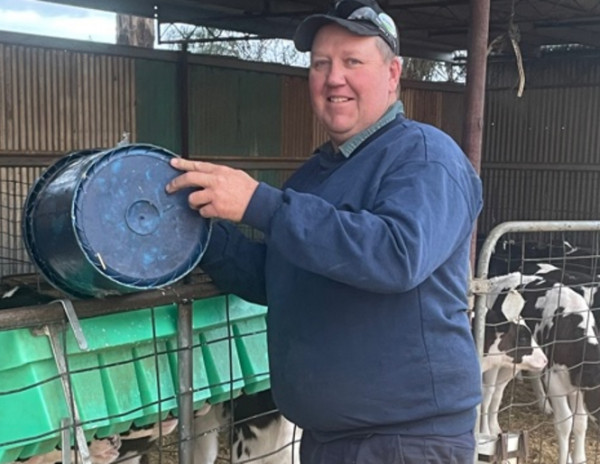
NEW Victorian Farmers Federation (VFF) water council chair Andrew Leahy may have just been appointed, but he is no spring chicken in the area of water advocacy.
The Murrabit farmer is himself a large irrigator and has seen his family farm grow from a small enterprise in 1983 to the large operation it is today.
Twenty years ago he would irrigate everyday, but now with less water he is more conscious to get more worth for his megalitres.
It has transitioned from a “back of mind” issue to something that is very much “front of mind”.
“It’s in your mind all the time, and can cause tensions between irrigators, and adds stress and cost for the farmer,” Mr Leahy said.
But the animals barely notice.
“They’re just like babies, they just eat and sh*t,” Mr Leahy said.
The warmer summers – with less grass – have added stress, but they are learning to deal.
Mr Leahy said it was an understatement to say this was an emotive issue, and has been involved in the politics for a while.
He was part of the advisory board for the Goulburn-Murray Water services, and has been part of the VFF council for 10 years, and deputy chair for five. He will now take over from Richard Anderson.
Mr Leahy also chaired the Plug the Pipe group, who opposed plans by a former state government to bring water from the Goulburn River to Sugarloaf Reservoir in Melbourne, over a decade ago.
Mr Leahy’s family has always been involved in water, and he deals with the topic daily both in his work as a dairy farmer and in his earthmoving business focused on irrigation layouts.
“North Vic has been vocal for decades,” he said
“Not everyone agrees, so we need to compromise.”
He said that in the northern Victorian region, we see the loss of water and it kept attention on the issue as people rely on this vital resource for income.
Two key focus areas for members were having a modern irrigation system into the future and the Murray-Darling Basin Plan.
The plan has certainly had its critics, and Mr Leahy said Victoria has done “most of the heavy lifting” and “given up a lot of high security water”.
“I can’t see how they (other states) could want to buy or get more. They should utilise what they have already got.”
Mr Leahy also highlighted how water in Victoria was carefully and conservatively used, in contrast to other states, and how water sent to other states could be used here for fodder or rice.
But as the chair of the state-wide council, there were water issues Mr Leahy must deal with around Victoria.
In Gippsland, there are negotiations for water to fill an area near the Yallourn Power Station while the western districts are dealing with drainage issues and sub-surface water.
He stopped short of saying that water was a divisive issue between farmers and those in the cities, but “it’s true that the money and the votes are in the city”.
“Everything is political, and I suppose we don’t have as many cousins down there any more to spread the message, but I would love to put on a TV ad to tell them where their food comes from,” he said.
“We’re not destroying the environment.”