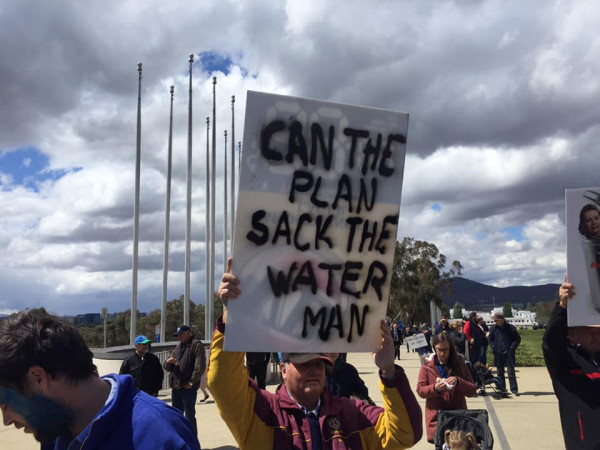
THE organisers behind the Convoy to Canberra have warned they will “up the ante” in 2020.
In a statement released this week campaign group Speak Up said the doomsday clock for the Murray-Darling Basin was ticking, and it’s “one minute to midnight”.
The dire prediction comes from the campaign’s Jan Beer, one of the “core group” desperately trying gain the attention of politicians and highlight the need for action.
In December, thousands of farmers descended on Parliament House in Canberra, calling for action to “fix or can” the planredoubling their efforts in the new year.
“The Murray-Darling Basin covers one million square kilometers, is home to 2.6 million people and is undeniably Australia’s major food bowl, producing 40 per cent of our nation’s food supply,” Mrs Beer said.
“Also, more than four million people rely on its rivers and catchments for water supply for families, community and industry.”
Mrs Beer said she sees the basin plan as a “dog’s breakfast”, that has done immense harm to the nation’s core productive irrigated farm enterprises, regional communities and reliant businesses.
Frustrated, she said many politicians refuse to admit “they’ve got it wrong”.
“Irrigation is the safeguard in case of drought, and is critical to our nation’s food security,” Mrs Beer said.
“We have become world leaders in water efficiency with our rice industry, as one example, producing more ‘crop per drop’ than anywhere else in the world.
“Yet the basin plan has pulled the rug from under farmer’s feet, removing within a very short timeframe 30 per cent of their most important resource and lifeblood, that being water.
“With the domino effect of drought and fires on top of this, food production is in serious decline and 2021/22 is looming as the time when the doomsday clock hits midnight if action is not immediately taken by governments, or we receive flooding rains in the meantime.”
Mrs Beer said “somehow”, farmers needed to get governments to understand the plan “is a disaster”.
“We cannot keep mismanaging and wasting our precious water like we’ve seen happen since the last flood in 2016,” Mrs Beer said.
With Murray-Darling Basin water storages at 32 per cent capacity, the northern basin is in “absolutely dire straits” with water capacity at just seven per cent and rainfall from January 27, 2016 to October 11 the lowest on record, a forecast of a very dry summer and autumn has promised little to no rain until winter.
“Despite this, we are not effectively managing these dwindling supplies,” Mrs Beer said.
“The Commonwealth Environmental Water Office (CEWO) does not appear to understand the extreme severity of the drought conditions throughout the entire basin, or the need to conserve as much water as possible, while allowing the environment to experience a drying period and adapt to the change in climate.
“Instead, the CEWO stated in its Southern Spring Flow Fact Sheet that environmental flows of eight weeks would be delivered downstream to the Lower Lakes and Coorong, as they had 400 giga litres of carryover water at their disposal.”
Mrs Beer said these flows utilised 99.9 per cent of water held in the Eildon Dam this spring, leaving “almost nothing” in reserve.
An act she branded as “irresponsible”, driving basin communities “ever closer to doomsday, when there will simply be no more water for basin human needs, as is the current case in many NSW areas”.
“We have already seen the effects of water mismanagement by the MDBA and environmental water holders, who drained the Menindee Lakes and Lower Darling, attempted to drain the Lachlan River and are now flushing water down the Goulburn system in the midst of an ever encroaching drought,” Mrs Beer said.
“Despite all this, state and federal governments continue to sit on their hands and procrastinate.”
Mrs Beer called on the Commonwealth Government to immediately quarantine the remaining environmental water, to provide water for critical human needs and “those non-human consumption requirements that a failure to meet would cause prohibitively high social, economic or national security costs”.
“The basin plan has proved to be totally inadequate at balancing human and environmental needs, to the detriment of agricultural industries, basin communities and our nation’s food security,” Mrs Beer said.
“It is time to stop the clock and fix it.”