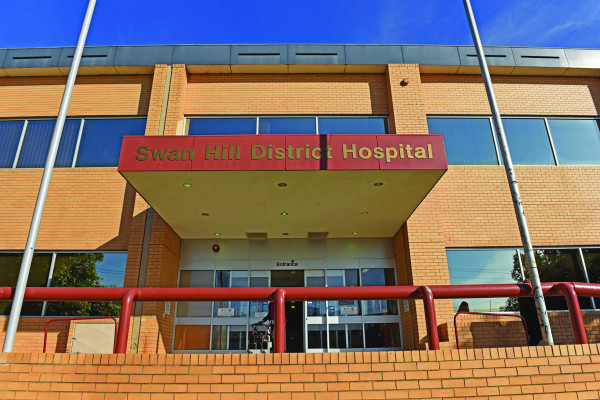
JUST 68 per cent of staff at Swan Hill District Health would recommend a friend or family member seek treatment at the health service.
The performance measure is one of a number in the annual Swan Hill District Health Quality Account Report, with the 2018-19 document released on October 30.
In the report, chief executive officer Peter Abraham outlined a commitment to improving the health service’s result on this measure, its lowest performance area.
“The vision of SHDH is to provide appropriate services in the right setting by dedicated people with and for our community,” Mr Abraham said.
“SHDH continues to evaluate and improve the care and services we provide to ensure our services remain consumer focussed, are integrated, better co-ordinated, so we can provide the best available care.”
The report measures performance from July 2018 to June 2019, with SHDH meeting or exceeding the state average on many measures.
“Throughout the reporting period, SHDH consistently reported a patient satisfaction rating of 90 per cent and above,” Mr Abraham said.
“Our staff rating for patient safety is 77 per cent, the state average is 70 per cent, and 68 per cent of SHDH staff recommend a friend or relative to be treated as a patient at SHDH, the state average is 72 per cent.
“SHDH has a strong commitment to improving our result in this important measure.”
Complaints against the service were down from last year, with 124 complaints, compared to 139.
The top three complaints were care provided, communication and facilities.
Compliments increased, from 195 the year before to 205 this reporting period.
The Victorian Health Experience Survey (VHES) for inpatients, asked overall, how would they rate the care received while in hospital.
SHDH received an overall patient experience score above the state average, and over 90 per cent for two quarters, but dropped below both for the most recent period of April to June.
Focus areas outlined to improve patient experience included strengthening the medical workforce by recruiting a geriatrician and senior medical officers to work in the emergency department and the acute ward, exploring the opportunity for nurse practitioners to work across community health areas within the hospital and providing ongoing education and support to staff in specialised areas to maintain and enhance their skill levels and the care they provide.
VHES for community health, completed from October-December, covered a range of SHDH community programs.
Responses said staff were “compassionate, considered all your needs, are polite and helpful, respectful and treat you with dignity, your concerns are taken seriously, you have confidence and trust in our staff and are comfortable to raise issues and ask questions”.
An overall experience rating of 99 per cent was returned, but according to the report, car parking was recognised as being “at a premium”.
The health service had two incident severity rating one incidents in the year, both of which have been reported to Safe Care Victoria in line with mandatory reporting requirement.
Review recommendations have included the introduction of a new program ‘speaking up for safety’.
The hospital has also undertaken revision and implementation of new documentation to recognise clinical deterioration of patients sooner, enabling care to be provided prior to the patient becoming critically unwell.
Across the organisation, SHDH reported 40 incident severity rating two incidents.
“Whilst this seems to be a large amount, it enables us to do case review on our processes and the care we provide,” the report reads.
“These cases are looked at in detail and to identify opportunities for improvement.”
Included in the incidents were 15 concerns with care and four in which injuries occurred to patients, staff or residents.
These occurred in the acute ward, emergency department, midwifery, radiology, operating theatre, aged care and allied health.
Swan Hill maternity services supported 167 families in bringing a new family member into the world in the 2018-19 financial year.
SHDH did not return comment before deadline.