Caitlin McArthur
cmcarthur@theguardian.com.au
SWAN Hill resident Ian Lindsay is urging residents to get their skin checked after an unusual freckle turned out to be a large melanoma.
Mr Lindsay has spent a lifetime working in the sun, and said he’s well aware of the threat posed by daily exposure to the harsh UV rays.
“I work outside, I don’t wear short sleeves and I don’t wear shorts,” he said.
“I have had a couple of melanomas cut out of my back in the past, and I’m cautious of marks on my body.”
Mr Lindsay said it was after having a carcinoma cut out of his cheek that the freckle on his nose caught the doctor’s attention.
“There was a little mark on my nose, and they thought it was a Hutchinson freckle (a melanoma with malignant cells, but that does not show invasive growth),” he said.
Mr Lindsay said he’d had the mark for about 20 years, and it had displayed some signs of not being a regular freckle.
“My nose kept getting this blood run over underneath the skin and doctors didn’t sort of know what to do,” he said.
“They said a dermatologist is coming in in six months, we’ll get them to have a look at it.”
Mr Lindsay said the dermatologist examined “all over” his body, before deciding to take a biopsy of the freckle on his nose.
“She rang back a couple of days later and said ‘it was a “massive” melanoma,” he said.
Mr Lindsay booked in for an operation on April 6, 2018.
“As soon as I was told about that I had a relation drive me straight down to Melbourne and a plastic surgeon down at Malvern, and he did that within 12 days,” he said.
The melanoma was removed over the course of two operations.
A discussion of radiation followed, but Mr Lindsay wanted to avoid it, with the area being so close to his eyes.
“They did all that and then they were talking about radiation above it, near my eyes, and I didn’t want that, so they gave me a cream and the district nurses paint it on with a match head, so it doesn’t touch their skin,” he said.
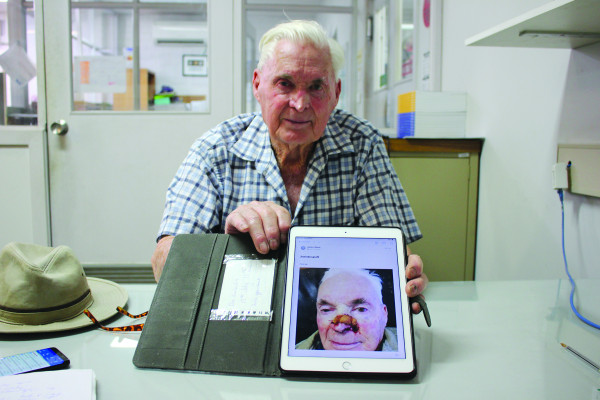
Mr Lindsay said he was given the all-clear at a check-up about 12 months ago, and was now hoping the photos of the melanoma will shock others into seeking doctor’s advice on any suspicious looking marks.
“I just thought, any marks people have on them, like that was just a little freckle, if you show those photos it could stir people up to really have a closer look at their body,” he said.
According to the Cancer Council Australia, skin cancers account for around 80 per cent of all newly-diagnosed cancers in Australia, with the majority caused by exposure to the sun.
In 2016, 1960 people died from skin cancer in Australia.
Cancer Council Australia advises people become familiar with the look of their skin to pick up on any changes that might suggest skin cancer.
Things to look for include any crusty, non-healing sores, small lumps that are red, pale or pearly in colour and new spots, freckles or any moles changing in colour, thickness or shape over a period of weeks to months.
Mr Lindsay said the tricky thing about skin cancer is you “don’t know you have it”, with the only sign a change in a mark or a new one on your body.
“I think it’s worth showing the photos, talking about it is one thing, but when you see the photo of what it was, just off a mark that you couldn’t see, hopefully people will take notice,” he said.