FIELDS of white gold are not a common landscape in Victoria, but a trial cotton crop near Lake Boga could be a catalyst for change.
Cotton production usually takes place further north in Queensland and New South Wales but an ambitious undertaking hopes to prove its profitability further south.
The major production area in New South Wales stretches south from the Macintyre River on the Queensland border and covers the Gwydir, Namoi and Macquarie valleys, with parts of the NSW Riverina — including Hay and Griffith — also producing the fibre.
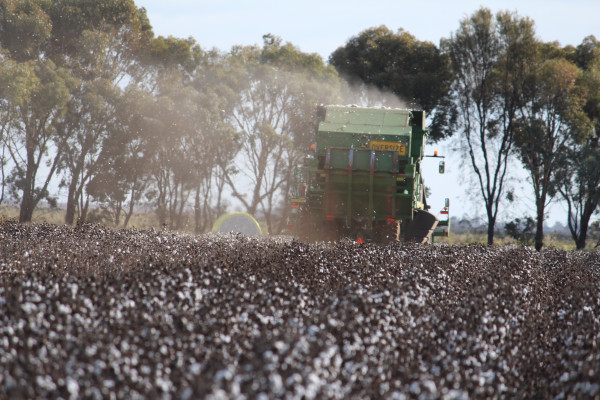
The 110 hectare crop near the banks of Lake Tutchewop, between Lake Boga and Lake Charm, is the first of its kind to be grown in Victoria on a commercial scale.
The investment from superannuation company VicSuper has proven “successful to this point”, with the real test to come when the bales hit the weigh-bridge following picking, which is underway.
Managed by Bendigo-based Kilter Rural, agribusiness manager Michael Neville said the company remained cautiously optimistic the crop would turn a profit.
Picking was in the process of restarting early last week after cold, wet weather forced a break in harvest.
The farm managed to get 10 hectares off, baling 14 “round modules” which were taken by truck to the cotton gin at Trangie — more than 750km away.

“We are pretty happy with it… but until we go across the weigh bridge we don’t really know what we have got out of it,” Mr Neville said.
“Being delayed because of the weather we haven’t lost anything but we are just hoping that it all goes to plan. You can only bale it below 12 per cent moisture in the cotton… because if you don’t get that right, they have a chance of catching alight and you don’t want that.
“So hopefully we will progress today, and have it tidied up in another six or seven days.”
Initial estimates predict the first harvest to be within range of a high yield crop.
The crop was sown in mid-October, but challenges with defoliation — getting the green leaf to drop off so the cotton can dry out — may affect the yield.
“The conditions at the end, once it had defoliated, had cooled and we didn’t get the bolls to open properly at the time,” Mr Neville said.
“We are aiming for 10 to 12 bales per hectare, but the average up north has been eight, so our expectations aren’t unrealistic — as long as we can get better than eight bales.”
The profitability of the initiative will be followed closely by stakeholders and interested parties.
A number of other crops are also being trialled by VicSuper in the area, including tomatoes — which yielded about 92 ton per hectare when harvested in January.
Other crops, including corn and sorghum are still in the ground.
Looking to next year, all going well, Mr Neville said they would look to double their area.
“It has got to be profitable enough for us to go forward,” he said. “It is a big investment, you are sticking $3500 to $4000 a hectare out there so we have to be confident that we can do better, but I think we can.
“We plan to double the area next year, and we will be better organised because we know what to expect.
“Some of the conditions are different down here to what they are up north so we just have to have a different management strategy as far as defoliation goes.
“We are waiting in anticipation like everyone else.”
With a cotton processing plant — or gin — being constructed at Hay, a major benefit in future pickings would be lower transport costs.
Rather than the 700km trek to Trangie, product would be transported to Hay, just 230km away.