
SCIENTISTS are hoping to learn more about threatened turtle species on the Murray River with the help of a new phone app.
Zoologists at the University of Western Sydney (UWS) have developed TurtleSAT, allowing people who spot a turtle to add their sighting to a nation-wide database.
The data will help researchers better understand where turtle numbers are declining and how to address the issue.
In just one month since the app’s launch on World Turtle Day, there have been 500 reported sightings, most of them in the Victorian Murray region.
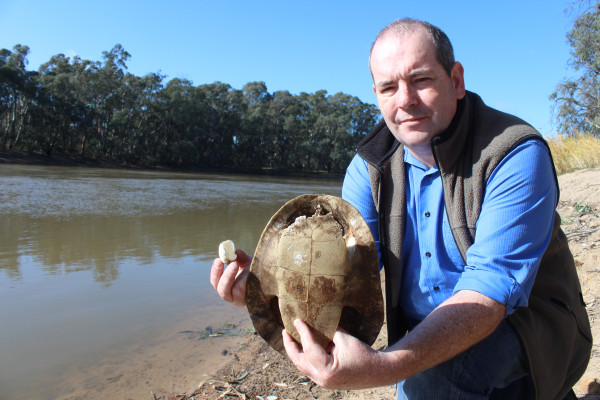
UWS Senior Lecturer of Zoology Doctor Ricky Spencer and his fellow researchers are targeting the Murray region around Swan Hill in the app’s early stages.
“That’s where the big issues are,” Dr Spencer said.
“We’ve found 95 per cent of nests get destroyed by predators.”
Since the 1970s, long-necked turtles have reduced in number by 90 per cent in some areas of Australia.
The broad-shell turtle is listed as endangered, while the short-necked turtle is threatened.
Researchers are less informed about Murray populations and are hoping the TurtleSAT app will help them fill the gaps and identify problem “hot spots”.
“We know that the whole of the Murray has decreased in turtle numbers. If it’s happening in the north and in Yarrawonga it’s happening here,” he said.
“But we have a chance to do something about it. We can look at where their prime nesting spots are and at where they’re being affected.”
Foxes are the major threat to turtles, ripping the heads and legs from their bodies, often to to get at the eggs inside.
Female turtles nest in open spaces, making them an easy target for foxes.
Turtles can live for as long as 75 years, if not longer, but researchers are noticing a significant decline in their numbers because of the lack of “recruitment”, or successful breeding.
This is bad news not just for turtles but for many other river species that rely on its delicate ecological balance.
Turtles are thought of as a vacuum of the river, efficiently reducing dead fish and other bacteria in just a few short hours.
“Turtles play an essential role in the ecosystem,” he said.
“They help maintain water health for plants and other animals by ‘vacuuming up’ algae and dead material and eating young pest fish, such as European carp.
“They’re really good at taking a big dead carp and breaking it down in just a few hours.”
But the future of Murray turtles is not entirely doomed.
By using TurtleSAT, Dr Spencer and his colleagues hope they can work to improve their number.
“If people report lots of sightings near busy roads or frequent road kills, you can mitigate their crossing, you can start blocking them from moving straight into that area and divert them instead,” he said.
“They’ve actually survived since the dinosaurs, so they’re pretty adaptable.”
Dr Spencer is asking people who spot turtles, dead or alive, to record the sighting using TurtleSAT.
“It’s about getting current and geographically accurate information so we can respond in the most efficient way to give turtles the best chance of survival.”