
ANZAC DAY: The next generation
ANZAC DAY: Story of an Aussie hero
ANZAC DAY: Forever connected by war
PHOTOS: Anzac Day around the region
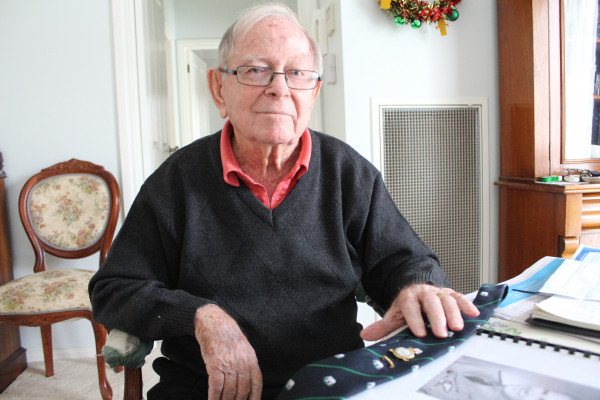
IN JULY 1944, Ian Murray’s mother received a telegram saying her son was missing in occupied France. Some 70 years later, the Swan Hill resident tells his amazing story to NIKI BURNSIDE.


IN PREPARATION for active service with the Royal Australian Air Force, Flying Officer Ian Murray was fitted with a parachute.
“And if it doesn’t work, don’t come back and complain,” one of the Women’s Auxiliary Air force joked.
Mr Murray tells this story with a laugh, like many of the other stories from his time with the RAAF, in which he flew an astonishing 26 operations.
Most did not survive numerous sorties over enemy territory.
Mr Murray, a Swan Hill resident who grew up in Mildura, joined the RAAF on his 18th birthday in December, 1941, but it wasn’t until June of 1942 that he first began at initial training school.
Originally hoping to train as a pilot, he was told he was too short, and instead volunteered as a bomb-aimer.
“Someone said, ‘oh we could have used a cushion’,” he says.
As a bomb-aimer, he was stationed at the front of the four-engine Lancaster bomber L for Lily, in a tiny bubble poised 8000 feet above the earth.
“I used to think a Lancaster was a small plane, but when I saw it at the War Memorial I couldn’t believe how huge it was,” he says.
He served for more than two years in No. 44 Rhodesia Squadron with Ted Greatz of Mildura, a navigator, together with five additional crew.
At one point, Ted found himself flying in the wrong direction over the English Channel, and Ian helped find the coordinates to bring them back on track.
“We helped each other,” Mr Murray says.
The 90-year-old father of three and grandfather of 14 has fond memories of the war, despite many of the trials and dangers he encountered.
One of his most vivid memories is of spending the night in a ditch, later awakened by the heavy drone of his airborne colleagues returning to England.
“My mother played the piano. And she stayed up all night while I was missing playing war time songs…”
He had found himself there after an operation to Stuttgart went horribly wrong on July 24, 1944.
At the time, Mr Murray’s mother in Mildura received a telegram saying he was “missing as result [of] air operations on 26th July 1944”.
“My mother played the piano,” he says.
“And she stayed up all night while I was missing playing war time songs.”
Mr Murray describes what happened that day as a great adventure.
L for Lily was accidentally bombed by a damaged Allied craft above and at first he didn’t realise how serious the situation was.
“Suddenly I felt the nose of our Lancaster dip, and thinking it was another slipstream, I took no notice until the skipper tersely called the engineer to help him with the ‘stick’,” Mr Murray’s account reads.
The skipper gave the order to prepare to abandon the aircraft, and as they did, all on board hoped the order wouldn’t come.
“But come it did, for the aircraft had gone into a dive and would respond only to the ailerons,” he says.
As bomb-aimer and with an adjacent escape hatch he was forced to bail out first and fell 7000 feet for what “seemed an eternity” before he saw the ground in the moonlight.
“As I got nearer the ground, I realised that I was being carried along backwards by a 10 mile per hour breeze. Thinking that my legs would be caught in the branches of the trees I doubled them up, and the next instant, to my intense surprise, I was tumbling head over heels in black grass.”
“As I got nearer the ground, I realised that I was being carried along backwards by a 10 mile per hour breeze. Thinking that my legs would be caught in the branches of the trees I doubled them up, and the next instant, to my intense surprise, I was tumbling head over heels in black grass…”
Mr Murray found himself in enemy occupied territory, sleeping rough in a ditch and a farmer’s hay barn.
Guided by the French resistance, Mr Murray was eventually reunited with all but one of his crew when secretly transferred to the Forest of Freteval, 160km South of Paris.
They spent about three weeks sleeping in the forest, using a parachute as a tent, and receiving help and supplies from the French underground.
The forest became legend after the war, the place where more than 120 aviators from the Allied army were hidden, living for months under the nose of the enemy.
They survived on food brought by friendly farmers, but “in the meantime we had nothing but beans, and only one meal a day,” he says.
Around this time, the Americans had liberated Cherbourg and were advancing across France. While they waited for news, the crew took risks to find food and visit shops in nearby villages.
They were taken in by a farmer and allowed to sleep in his barn.
The next morning they woke to good news.
An American soldier arrived in the village abruptly, and in an almost Hollywood style close to their adventure, said to the crew: “Any of you bastards speak English?”
They were rescued and returned to England, where Mr Murray sent his mother a telegram.
It simply read: “I am back in the pink.”
“She didn’t know what it meant,” Mr Murray says.
“At that time the British Empire was coloured pink on maps, and that was how I told her I was safe.”
Mr Murray still remembers fondly his three weeks stranded in France in 1944.
“It was an adventure,” he says.
After his return to England he was presented with a caterpillar pin, indoctrinating him into the Caterpillar Club.
“I just thought, ‘you stupid clot, why did you drop your bomb on me?’…”
The group is an association of those who have successfully bailed out of their disabled aircraft.
Asked what he was thinking as he bailed out of his Lancaster, he doesn’t mention fear.
“I just thought, ‘you stupid clot, why did you drop your bomb on me?’”
This Anzac Day, Mr Murray said he would watch the service and reflect on his experience — one which is still as vivid in his memory as it was in 1944.
Pick up a copy of Friday’s special Anzac Day 2014 commemorative edition of The Guardian.