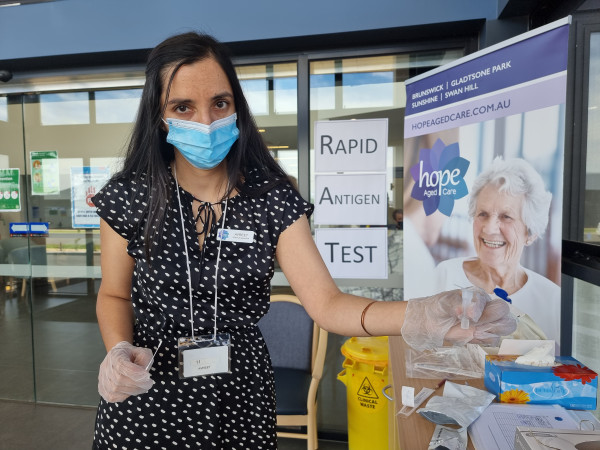
HOPE Aged Care residents are able to have morale-boosting visitors thanks to the introduction of rapid antigen testing (RAT) that produce results in just 15 minutes.
Owner of Hope Aged Care Professor Afif Hadj is a retired oncology surgeon who owns four aged care homes in Victoria, and he implemented these changes to allow residents some normality despite the current outbreak in Swan Hill.
“What devastated Melbourne last year was the presence of the virus in aged care homes,” Prof Hadj said.
“The virus was introduced by infected staff, who unwittingly came to work not knowing they were infected and infectious.
“All aged care workers are now vaccinated, as are the residents.
“However, a person can still be infected even though they are fully vaccinated.”
Professor Hadj explained that visitors can be infected and asymptomatic but, with the facility’s use of RAT, residents and staff can be protected from coming across the virus within the centre.
Each staff member is tested before starting their shift in addition to bi-weekly PCR tests that the public may have had, while visitors are tested at the door.
This week in one of the Melbourne homes a doctor completed the RAT that showed the fully vaccinated, asymptomatic staff member was positive.
He then returned home preventing any infection from spreading.
“That way we do not have a lockdown and our residents can still have visits from family and friends,” Prof Hadj said.
“Our staff can also come to work knowing they are in a COVID-free workplace.
“Hairdressers, entertainers, et cetera can come knowing that they have tested negative to the virus just before entry.”
This service does come with a price at $5 per test and around 50 tests per day including 35 staff, but it keeps the most vulnerable safe while allowing residents to interact with their loved ones.
Prof Hadj also tested his staff twice weekly back when the general PCR tests were $100 each, spending around $80,000 before the government made the test a Medicare item.
He does not know if the RAT will be subsidised outside of hotspots, but as it is the tests are a “win-win”. They keep his business open while protecting his residents.
As a surgeon he brings his understanding of infection – “the enemy” – to his business and has managed to prevent any cases reaching residents in his facilities during the pandemic so far.
Hope Aged Care chief executive Philip Moran said the RAT is “one more tool in our armoury”.
“We have to have enormous compassion for residents within the guidelines in which we operate,” Mr Moran said.
Prof Hadj has introduced these testing changes in all of his facilities, but has never locked down his facilities in Melbourne, even last year.
“I can understand facilities going into lockdown, and I make no judgments on what a facility does,” he said.
“However, I believe that the harm done to residents being deprived of visitations from their loved ones (especially those with dementia) is great.
“In my memory support unit, it is clear that visits by relatives are vital for the wellbeing of the resident.”
The facility cannot mandate vaccinations for relatives, although these protect a person from severe illness and make them less infectious if they do become infected, but the RAT’s 99 per cent accuracy is a comfort as Australians try to manage life with the virus.