
RELATED STORY: Harmony Day success
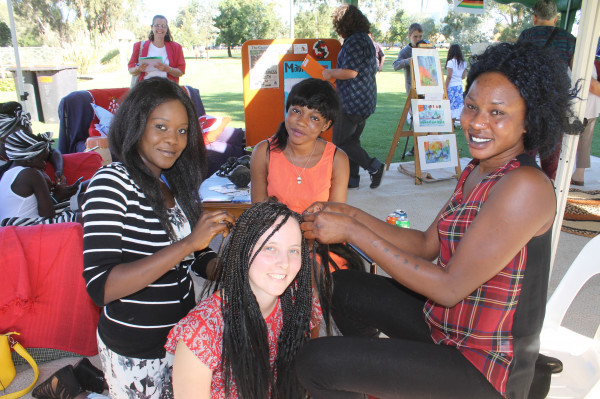
THE Guardian journalist NIKI BURNSIDE got involved in the Harmony Day festivities at Riverside Park at the weekend. She volunteered to have her hair styled in traditional Sudanese braids by Achol, Mary and Shortie – and got to know a bit about the three ladies and their culture along the way. Here she writes of her experience…
ON the weekend I temporarily gave up my journalist’s hat and had a Harmony Day transformation.
Instead of being the media observer, watching others engaged in events and activities in our region, I was an active participant.
The idea for a Salon Exchange at Harmony Day had been brought up a few weeks before and I had casually volunteered to be involved.
The event was all part of Gifts of Translation, introduced by Outback Theatre for Young People, and an ongoing program of theatre, dance and cultural sharing.
I am not usually one for changing my straight brown hair. I don’t dye it, or curl it, or even cut it in any interesting styles.
So on Saturday when my new friend, Achol, and her friends sat down around me and began turning me into a whole new person, it was an entirely new experience.
That is what Harmony Day is all about. It was a day of firsts not only for me but for lots of those who came along to try different cuisine, get henna tattoos and dance to Afghani singer (and superstar) Taqi Khan.
Achol is originally from south Sudan and she speaks a few languages, at least two. I heard three languages spoken as I sat having my hair braided for three hours.
After a while, they all sounded the same, and I thought I could guess sometimes what they were saying.
At the very beginning they were debating how to handle my hair.
It’s stubborn, soft hair that isn’t easily braided. No matter what you do to it, it won’t stay there long.
“In the end, what seemed at first to be a very unusual experience became something very familiar, a ritual shared by women across cultures all over the world…”
Achol didn’t ask my permission to do anything to my hair, which was fine with me. I’ve never met anyone like her. She is blunt and straight to the point. She told me she was going to cut my hair and I, naively, thought she might do it like other hairdressers I’d been to over the years.
Instead, she cut off more than two inches in about two seconds.
It was suddenly gone.
I took a deep breath and realised I would have absolutely no control over what would be done to my locks. It was oddly liberating, and so I left them to it.
There is something very soothing about having three or four women on all sides of you, their warm hands taking strands of hair and braiding them.
I talked to them about what they were doing. The process, which is so foreign to me, is the most natural part of their lives.
Shortie, sitting in front of me and helping hand the others strands of hair, said they had always had their hair braided by their mothers.
Looking around, I saw lots of south Sudanese girls running around with amazing hair, every one of them with an individual style.
Every now and then one of the women would swap and start doing some hair. She’d sit in front of me with a smile and say, “you’re going to look beautiful”.
Members of the community walked past and I watched them become entranced by the sight of Achol, Mary and Shortie’s fingers moving so quickly as they did one braid after another.
One lady talked about how as a girl her mother would put two plaits in her hair before school.
Every now and then it would be painful as they tugged at my scalp, working the hair away into a braid. That reminded me of being about five years old and my mother ruthlessly scraping my hair into plaits for school, or a fountain ponytail on top of my head, because that apparently was such a great look.
Achol reminded me of my mum a lot, with her short, blunt sentences and the lack of sympathy for my pain.
They’re both tough ladies, although Achol has been through very different things to my mum, fleeing war-torn Sudan for Egypt — where she learnt Arabic — before migrating with her family to Australia.
Now she is a mother herself to a little boy.
In the end, what seemed at first to be a very unusual experience became something very familiar, a ritual shared by women across cultures all over the world.
After one-and-a-half hours, I had long, black hair braided into my own, showing the contrast between the two shades. I felt like a different person. People stopped to admire the braids and I got to experience what it was like to look different to how I usually do.
Later on I danced with others to the amazing Taqi Khan. Nykuia, a little girl from the south Sudanese community, danced past me, ran her fingers through my hair, and said, “very beautiful”.