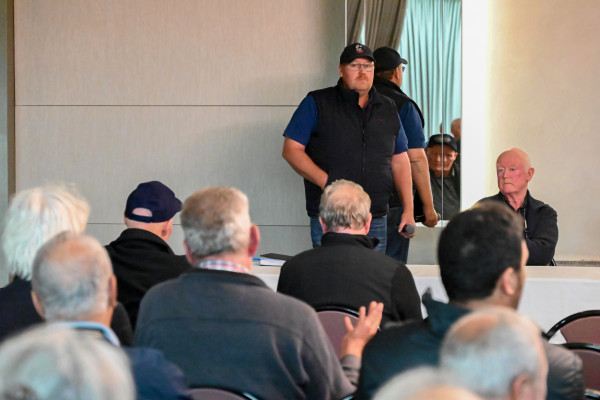
MURRABIT dairy farmer Andrew Leahy says taking water from food production in exchange for a $300 million “sugar hit” is a “slap in the face” for the regions.
Mr Leahy said the funding package announced by Water Minister Tanya Plibersek would go nowhere close to what would be required to support communities targeted for water buybacks.
“Taking out $111 million of agricultural production every year and replacing it with a one-off $300 million package will do little more than paint some town halls,” he said.
“Ten years of lost agricultural production based on the government’s own flawed numbers would see over a $1 billion loss in agricultural production.
“Regional communities depend on thriving agricultural industries. A billion-dollar loss in agricultural output will result in schools having to close and job losses across multiple industries.
“A $300 million sugar hit is no solution.”
Ms Plibersek said the Federal Government was “supporting” regional communities with the $300 million injection.
Under the Sustainable Communities Program, states will work directly with basin communities affected by voluntary water purchase on “investments that create and support local jobs and businesses”.
Ms Plibersek said investments could include kickstarting or expanding industries in regional communities that were less water-dependent, new community infrastructure projects, workforce development and community support services.
“These measures will support Murray-Darling Basin communities as 450 gigalitres of water is progressively returned to the environment by 2027,” she said.
“The support program has been informed by community feedback, work with state and territory governments, lessons from previous water recovery programs, and the latest research.
“In the meantime, our government continues to explore and prioritise all viable water-recovery options to lessen the impact on communities and the irrigation sector.
“Delivering on our election commitment, the recovery of 450GL of water to the basin will help restore native wetlands and riverbanks, better connect our rivers, and avoid critical species loss.”
Ms Plibersek said the Federal Government was “listening carefully” to regional communities.
“We understand there may be social and economic impacts of recovering water,” she said.
“That’s why we’re providing a record $300 million support package for basin communities before water-recovery impacts are felt, supporting jobs and economies. It will ensure regional communities are as strong as possible as the basin plan is rolled out in full.”
Groundwater doesn’t cover loss – VFF
WATER buybacks reduce the water available for food production and drive up prices, according to new data.
“Australian Bureau of Agricultural and Resources Economics and Sciences found average water prices will increase by $53 per megalitre in northern Victoria from $401 per megalitre to $454 per megalitre,” farmer Andrew Leahy, who is also Victorian Farmers Federation water council chair, said.
“This is about half of what other reports have estimated, because they assume water purchases of 225GL, and not the full 450GL, would only reduce water use by 133GL.
“They assume that groundwater use would increase to replace lost surface water. In practice, we know the basin plan caps groundwater use and suitable groundwater resources are simply not available in many areas.
“The ABARES analysis focuses on changes in water prices but ignores the catastrophic costs that reducing the amount of water available for consumption during droughts.
“They talk in averages. We know that if the Millennium Drought is repeated, 40,000 acres of trees in horticulture will be lost, but the ABARES report finds water purchases would cause little impact to almonds and horticulture.
“Despite the limitations of the ABARES report, they still find that Commonwealth water purchases hurt agriculture and rural communities. ABARES also cast significant doubt on other reports prepared by South Australian academics that trivialise economic impacts in NSW and Victoria.”
NSW Irrigators’ Council said the ABARES report showed Murrumbidgee and mid-Murray valleys would be the areas hardest hit by water buybacks driving up prices and reducing production.
NSW Irrigators’ Council chief executive Claire Miller said these basin communities already struggled to survive droughts when water was scarce and too expensive to grow key crops such as rice.
“This report shows more government buybacks will add to costs and water scarcity, leaving these and other vulnerable communities in an even more precarious position,” Ms Miller said.
“Murrumbidgee and mid-NSW Murray communities have little scope to diversify their economies beyond irrigated agriculture – if they could, they already would have done so in response to the price and production impacts of previous buybacks.
The report said additional water recovery would hurt the Murrumbidgee Valley and the Murray Valley above the Barmah Choke, with the rice industry taking the biggest hit among basin commodities.
Northern Victoria is also vulnerable, but ABARES admits it does not have the data to properly model dairy impacts.
“The government’s announcement of $300 million to assist Murray-Darling Basin communities will barely touch the sides on what irrigation-dependent communities will need,” Ms Miller said.
“The economies of agricultural communities are all linked to production. If water buybacks proceed then communities will need much more than a local sugar hit.
“Job losses will extend to rural supply stores, hairdressers, frontline services and hospitality. If agriculture suffers then the whole community suffers.
“When water prices are already high in a drought, that extra added by buybacks is the straw that breaks the camel’s back for many farm enterprises.”