
IN AN underground bunker at Lake Boga, three men have just made contact with Switzerland.
This may not seem like anything unusual at first — we are after all living in a digital world, an age of instant connectivity.
But these men aren’t using the internet, they aren’t using a phone, they aren’t using any form of modern gadget — they are communicating with morse code.
Dash-dot. Dot-dash-dot. Dot-dash.
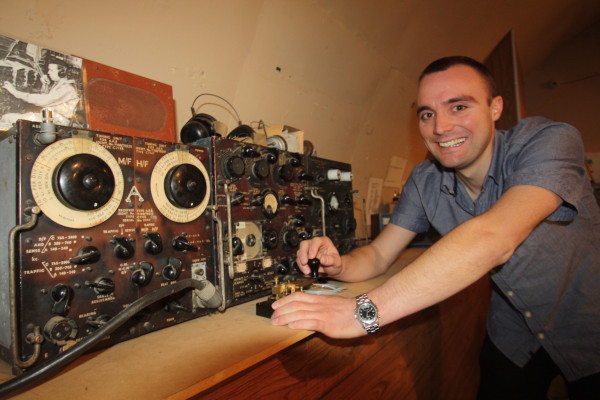
For the first time since World War II, morse code transmissions are being sent and received from the underground communications bunker, now part of the Lake Boga Flying Boat Museum, by Swan Hill amateur radio enthusiasts Thomas Brownstein, Aubrey McKibben and Andrew Manning.
Mr Browstein, a 25-year-old metal fabrication student, has been the driving force behind getting the bunker back on air.
“I came down here in 2012 and thought ‘wouldn’t it be great to transmit from here’,” he said.
“I contacted the Lions Club and they were really enthusiastic about it.”
Using original radios from WWII, as well as more modern equipment, the trio has already made morse and voice contact with other radio operators all over Australia and the world since April.
The bunker is believed to be the only one in Australia that is still sending and receiving transmissions.
It has been a particularly exciting project for Mr Brownstein, who has had a keen interest in radios since his dad bought him a crystal set when he was four years old.
“It is basically the most simple radio there is — it gets all its energy from radio waves.
“I used to sit under the tank stand and tune into the local radio stations.”
At age 14, Mr Brownstein decided to sit for his amateur radio licence, which included a morse code exam requiring a speed of five words per minute.
Two years later he sat for his advanced licence.
He now transmits morse code at a speed of 15 to 20 words on a hand key, and 25 words per minute on an electronic key.
While almost obsolete in general society, morse code is still considered an important form of emergency communication and is still very popular among amateur radio operators like Mr Brownstein.
“I’m not really old-fashioned — I’m quite technologically-minded,” he said.
“There’s something much more personal about [amateur radio] than the internet.
“When you make contact with someone, you know you’ve got a shared interest and they’ve had to pass an exam to get their licence too.
“But it’s not just about the contact. It’s pretty miraculous that an electrical signal can leave the radio in front of me and travel an enormous amount of distance between thin air to another person on the other side of the world.”
While it is mostly used for fun, if an amateur radio operator hears a distress call they must legally respond.
Just recently Mr Brownstein came across a distress call from a stricken yacht off the coast of New Zealand.
“I waited until I heard the coast guard respond,” he said. “But if there wasn’t a response it would have been my legal responsibility to respond and call Triple Zero.”
Mr Brownstein said he planned to form an official amateur radio club in Swan Hill.
“We’ve got three amateurs working and making contacts at Lake Boga.
“But it’s not official — we need a club.
“It’s a great hobby — it’s like a social network.”
Anyone interested in amateur radio can contact Mr Brownstein on 0433 662 566.