THE AFL is preparing to release its updated community football concussion guidelines for 2024, with footballers from state to community level to miss three weeks play following a concussion.
In early March, the league announced they would be adopting recommendations from the Australia Institute of Sport’s Concussion and Brain Health Position Statement, in another step to protect players.
The concussion guidelines are reviewed every year, and updated accordingly by the AFL’s chief medical officer, the league’s medical working group and the AFL’s concussion scientific committee.
Speaking last year when the AFL released their 2023 updates, current chief medical officer Dr Michael Makdissi described concussion as “an extremely important issue across our industry”.
“The health and wellbeing of all players who choose to play our game, at all levels from grassroots through to the elite game, remains a priority,” he said.
This season, grassroots footballers will need to sit out 21 days after sustaining a concussion, nine days longer than their elite AFL counterparts.
The variance is due to the high level medical resources available to AFL footballers that local footballers do not have.
The AIS’s statement suggested that players under the age of 19 across all levels should sit out for 21 days, but it was determined that different protocol for different age groups was “impractical”.
AFL general counsel Stephen Meade described the upcoming guidelines as “a significant step in the AFL’s existing record of ongoing improvements to its concussion management strategy.”
“We play a contact sport and there is always going to be risk, however over recent years we have continued to take action to strengthen match-day protocols,” he said.
“While there are risks of injury in our sport, we will continue to act to reduce and manage those risks.”
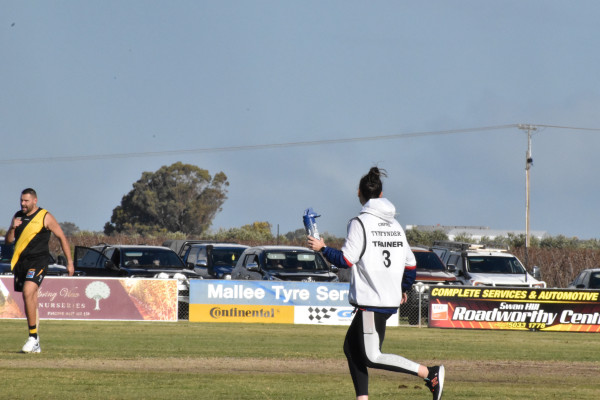
Through her role as a football and netball trainer, 26-year-old Swan Hill resident Milly O’pt Hoog has seen first-hand what players risk each weekend.
She described witnessing a head injury during last year’s finals as sickening.
“Last year in one of the finals, a kid at the club I’m at attempted an intercept mark and just got taken out in the air,” she said.
“Some ladies got footage of the incident, and in that you could tell that he was out cold when he hit the ground.
The experience was an eye-opening one for O’pt Hoog, who said trainers rushed onto the field to assist the injured player.
“We have to just basically stop the whole game,” she said.
“You run out there and you start working your spinal stuff first, because you just don’t even know how severe it is and then we kind of just wait till the player comes to.
“In that incident, you could tell as soon as he came to, he was barely able to speak, could barely open his eyes; his eyes would just roll back into his head.
“You’re running out there as a trainer and you’re thinking: ‘holy crap, is this guy still alive? Will I be responding to any major trauma?’”
O’pt Hoog also wants people to understand concussion isn’t solely a football issue.
“You don’t normally get concussions in netball, but I’ve seen a girl who got an elbow to the head on the court,” she said.
“I just saw her crawling off the court. She was still conscious, luckily, but she told people she was dizzy and then just started spewing everywhere.
“I guess the two different situations were both concussions, but they can present in such different forms.”
O’pt Hoog believes that more people need to openly speak about concussion, before more people’s lives are impacted.
“I have heard from around other clubs where people have said ‘Oh don’t say the C word, don’t say the concussion’.
“As soon as you hear it people are like oh maybe he can’t play for 12 days or whatever.
“But we can’t have that negligence; we’ve got to be putting our players first.
“Whether that does mean they miss two rounds, it could mean they are not going to be more at risk of mental health concerns or cognitive issues later in life.”
O’pt Hoog would like to see mandatory pre-screening of players at local levels.
“The AFL is recommending that all players, all footballers go through a pre-screening,” she said.
“It can be a little annoying and time-consuming, but that’s what the AFL recommend we should be doing.
“It’s difficult for us to know if a player just wants to return to play, and how they are doing without that baseline to go off.”