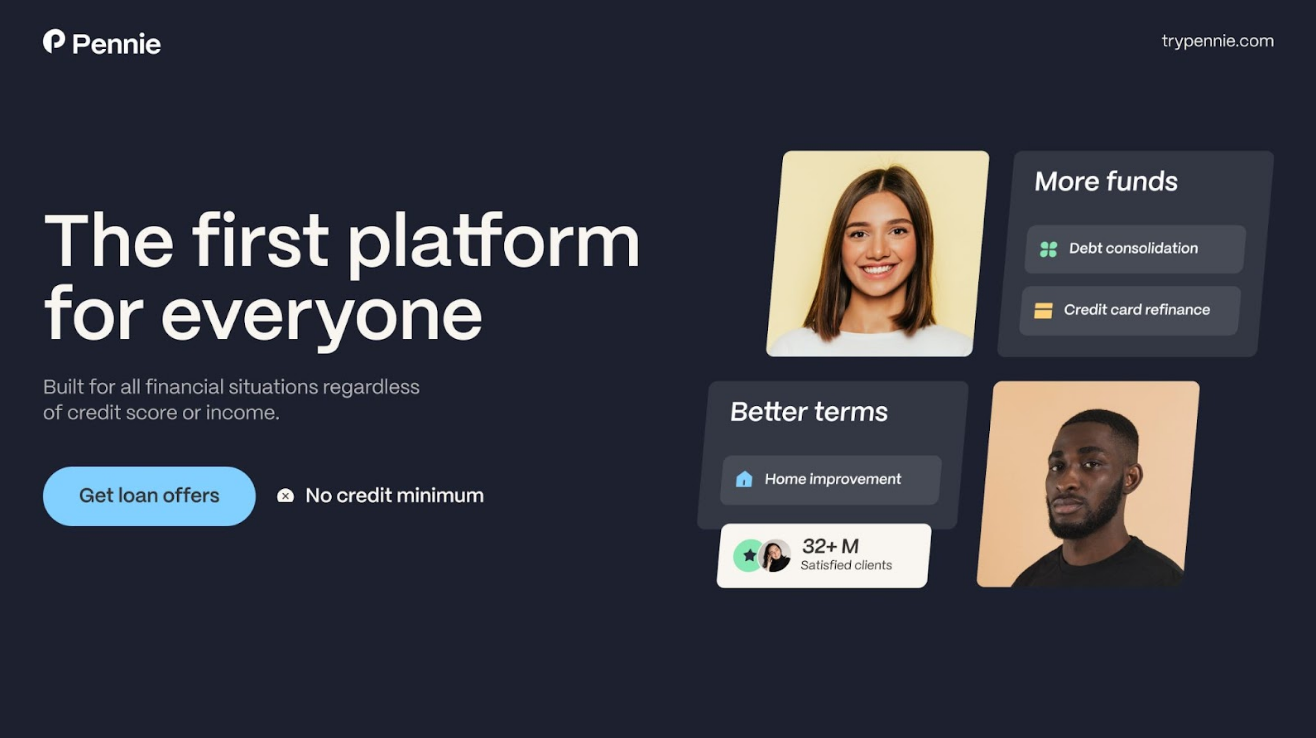
A loan marketplace that doesn’t sell your data, qualifies borrowers with an emphasis on income, not just credit scores, and has funded 32 million people? We looked into whether Pennie lives up to the claims.
No minimum credit score. A 60-second application. Funding as soon as next day. Loan amounts up to $250,000. And a promise to never sell your data.
On paper, Pennie sounds like exactly what frustrated borrowers have been waiting for. But in an industry filled with bait-and-switch tactics and lead generation schemes, skepticism is warranted. So we took a closer look.
The Claims
Pennie, the loan marketplace at trypennie.com, positions itself as a consumer-first alternative to traditional lending platforms. The pitch centers on three things:
- Income-focused qualification — Borrowers are matched with lenders who evaluate earning power and employment stability, not just credit scores
- Privacy protection — Pennie does not sell or share customer data with third parties
- Scale — The platform has funded 32 million people and delivered 350 million loan offers in 2024
For borrowers who’ve been rejected by traditional lenders or burned by platforms that sold their information, these promises hit differently. But do they hold up?
What We Found
The income-focused model is real. Unlike platforms that require a 620+ credit score just to see offers, Pennie connects borrowers with lenders who consider income, employment history, and ability to repay. This income-driven approach serves people whose credit scores don’t reflect their current reality — workers recovering from job loss, medical debt, or divorce who now have steady paychecks but damaged credit histories.
The privacy commitment checks out. Pennie uses soft credit inquiries that don’t affect borrower scores at the offer stage. More importantly, the platform does not sell customer data — a sharp contrast to lead generation sites that monetize applications by passing information to dozens of third parties.
“The old model treats borrowers like products to be sold,” said Sam Mkhitaryan, Co-founder of Pennie. “We built something different — a platform where people can see real offers without their data becoming someone else’s revenue stream.”
The numbers are substantial. 32 million people funded through the platform. 350 million loan offers made in 2024. Over 200 million customer inquiries processed. These aren’t projections — they’re scale that reflects real borrower demand.
Borrowers are responding. Pennie holds a 4.9 rating on Trustpilot. Reviews consistently cite the fast application, multiple offer options, and respectful process — a stark contrast to the spam-heavy experience common on other platforms.
What’s The Catch?
Pennie is a marketplace, not a direct lender. That means the platform connects borrowers with offers, but final approval, rates, and terms are determined by individual lending partners. Loan amounts up to $250,000, repayment terms up to 10 years, and APRs starting at 5.99% are possible — but what any borrower qualifies for depends on their profile and the lender’s criteria.
This is standard for any loan marketplace. The difference is how Pennie handles the process: borrowers review offers in a private dashboard and choose whether to proceed, rather than being bombarded by outside sales calls.
The Verdict
Is Pennie too good to be true? Based on what we found, the answer is no — with a caveat.
The platform delivers on its core promises: income-focused lending that serves borrowers traditional lenders overlook, genuine privacy protection, and a streamlined process backed by real scale. For everyday Americans whose credit scores don’t tell the whole story, Pennie offers a legitimate path to personal and consolidation loans.
The caveat is that no marketplace can guarantee approval. But Pennie does what a good marketplace should: give borrowers options, protect their data, and let them make informed decisions.
For a lending industry built on selling borrower information, that’s not too good to be true. It’s just better. For more information, visit trypennie.com.
Frequently Asked Questions
How do I qualify for a Pennie Financial personal loan?
Qualifying is straightforward. You’ll need to be at least 18 years old, have a valid U.S. address and Social Security Number, and have verifiable income. You’ll also need an active bank account where funds can be deposited.
While most lenders are credit-focused, Pennie is income-focused. The lending partners on the Pennie platform look at your ability to repay — your income, your expenses, your overall financial situation — rather than relying solely on a credit score to make decisions.
What types of income qualify?
Pennie accepts many forms of income, as long as it’s consistent and can be verified:
- Employment income (W-2)
- Self-employment and freelance income (1099)
- Social Security benefits
- Disability income
- Retirement or pension income
- Military pay and benefits
- Alimony or child support
- Rental income
- Other documented income sources
The common thread is that you have money coming in regularly and can show documentation of it.
Can I get a loan with bad credit?
Yes, it’s possible. That’s a big part of why Pennie exists.
Traditional lenders often turn people away based on credit scores alone, without considering the full picture. Pennie’s lending partners take a different approach — they look at your income, your current financial situation, and your ability to make payments.
This doesn’t mean everyone gets approved, and it doesn’t mean credit history is ignored entirely. But it does mean you have a real chance to be evaluated as more than just a number.
What documents do I need?
To get started, you just need basic information — the initial application takes about 60 seconds.
If you move forward with an offer, you may need:
- A government-issued ID (driver’s license, state ID, or passport)
- Proof of income (pay stubs, tax returns, or bank statements)
- Proof of address (a recent utility bill, lease, or bank statement)
- Your Social Security Number
- Bank account details for receiving funds
Different lenders may have slightly different requirements, but these are the basics.