LOYAL customers and retailers are the losers in Akubra’s exodus from most rural stores, leaving online and metropolitan stores as the only option.
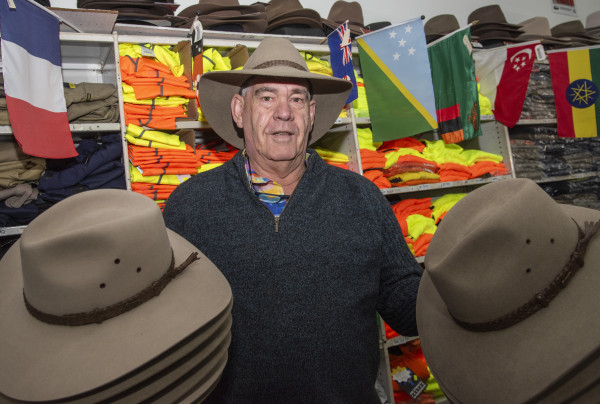
Swan Hill Disposals is the last Akubra retailer in the region but has been given notice that it will be cut off from stocking the brand from 2025, with no indication of a future return to local shelves.
Swan Hill Disposals operator Daryl Billing expects disappointment in the community which has sported Akubra for decades, as well as damage to his bottom line.
“What else can I stock that has the same revenue and brand loyalty?” Mr Billing asked.
Mr Billing had no option to negotiate the terms of Akubra’s decision, which includes returning remaining stock to Akubra after the supply period finishes in early 2025.
Akubra had reached its production ceiling at the time it was bought by Andrew Forrest’s Tattarang in 2023, employing 120 people in the Kempsey, NSW, factory and producing 240,000 hats annually.
Former chairperson and descendant of the founder of Akubra Stephen Keir cited the lack of finance to increase production capacity as the reason to sell the business.
“We thought long and hard about selling the business after five generations of family ownership, and after we saw how the Forrests have invested in local manufacturing with R.M. Williams we decided they were the right custodians for Akubra,” Mr Keir said.
Since Tattarang acquired R.M. Williams for $190 million, the company has built two new production lines and hired 500 new workers in the Adelaide warehouse.
Billing’s patience through Akubra’s COVID-19 warehouse closure, worker shortages and supply delays, to which his order is still capped at nine hats per month, will not be rewarded.
There has been an Akubra retailer in Swan Hill since the brand was born 148 years ago, and Mr Billing has been among those selling the iconic hats for almost 30 years.
Swan Hill Disposals supplies Akubras to a clientele over a radius of more than 200km to a demographic that has been shopping in brick-and-mortar stores all their lives.
Farmers 65 years and older in rural and regional areas are twice as likely to die from skin cancer as other Australians, with skin cancer diagnoses expected to rise from 8000 in 2021 to 11,000 in 2030, according to a 2014 National Rural Health Alliance Inc report.
The Cancer Council recommends clothing such as hats, long sleeves and trousers to cover as much skin as possible as the best protection against UV damage.
“The Akubra has long been a symbol of the Australian bush and we remain committed to our regional customers,” Akubra said in a statement.
“We will continue to have more than 200 stores selling our hats across Australia.”