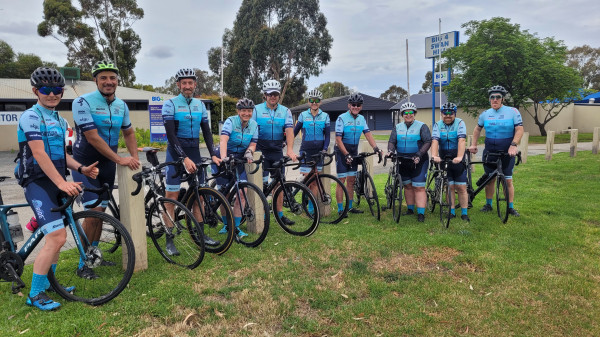
SWAN Hill welcomed a hardy group of 11 cyclists this weekend on a 1200km trek to raise vital research funds for ovarian cancer.
The team is undertaking the physical Silver Lining Ride from Mildura to Melbourne while more than 100 fundraise around the country by riding 1068km around their towns or in the gym this November.
The 1068km signifies one kilometre for each woman who died from ovarian cancer in Australia last year.
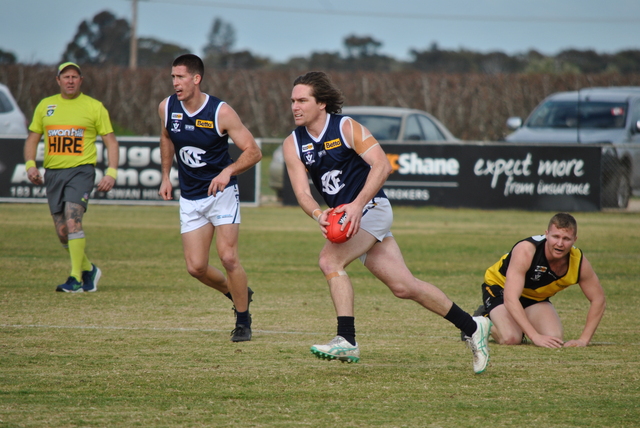
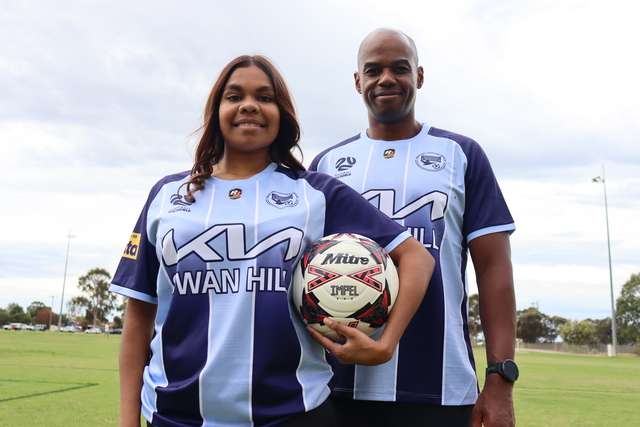
Arriving in Swan Hill from Ouyen on Saturday, the group included Silver Lining co-founder Georgie Herbert who lost her mother in 2017 to ovarian cancer and former AFL player Campbell Brown who lost his mother to the disease in 2019.
The Silver Lining Ride raises awareness of ovarian cancer and funding for the Ovarian Cancer Research Foundation (OCRF), as well as low survival rates, with women in regional areas facing the added challenge of accessing timely treatment after diagnosis.
Riders will visit nine regional towns – Ouyen, Swan Hill, Echuca, Yarrawonga, Wangaratta, Shepparton, Bendigo, Ballarat and Sorrento – before ending in Melbourne on November 28.
OCRF CEO Lucinda Nolan said ovarian cancer is the most lethal gynaecological cancer, though it is critically underfunded.
“Unless this changes, we will continue losing mothers, wives, sisters, daughters, and friends,” Ms Nolan said.
“The OCRF funds research into ovarian cancer to improve lives today and save lives tomorrow.”
“The five-year survival rate for breast cancer is 91 per cent, 83 per cent for uterine and 71 per cent for cervical.
“For ovarian cancer, it is 46 per cent.”
Looking for a Silver Lining, former Hawthorn and Gold Coast AFL strongman Campbell Brown has saddled up again to help raise money for research and awareness of ovarian cancer, which took his mother Kay in 2019, two-and-a-half years after her diagnosis.
Campbell raised almost $11,000 in the 2020 Silver Lining Ride, which was held virtually over 1068 km due to COVID-19.
Campbell says his mum fought hard, but two eight-hour operations, radiotherapy, and chemotherapy could not save her.
Kay’s chances may have been improved if she was diagnosed earlier and he wants others to benefit from the development of an early detection test and better treatment options.
He also wants to promote the importance of regular health check-ups, which may have been trickier to attend during the pandemic.
“That figure that 1068 women will lose their lives with ovarian cancer [in Australia] every single year, that’s just massive,” he said.
“It’s called a silent killer for a reason.
“With ovarian cancer you sometimes don’t know until it’s too late.
“That was the case with my mum.”
Kay was as “fit as a fiddle” until she was about 68. She was diagnosed in 2017 and the initial operation to remove the tumour was successful.
But within a month the doctors found the cancer had spread to her brain and soon after it was found in her spinal fluid.
“That couldn’t be cured and eventually it made her paralysed,” Campbell said.
“It was just riddled right throughout her body.
“Checking her into respite was probably the toughest moment, knowing that the end was coming.”
Kay had no obvious symptoms, emphasising to her son the need for early detection and helping inspire him to become an OCRF Ambassador.
To donate to Campbell or another rider, and assist the vital research into early disease detection, visit silverliningride.com.au