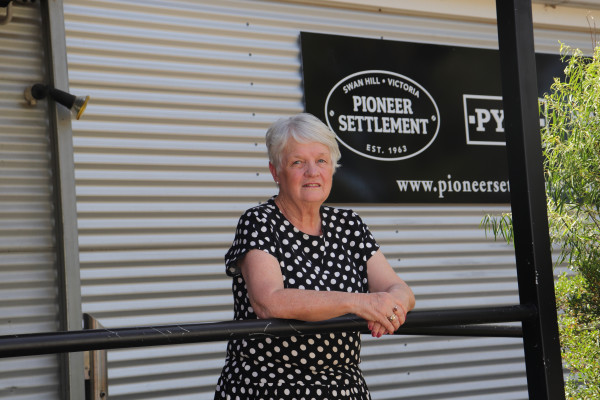
IN a public submission to the Heritage Council of Victoria, Ann Young, writing as a resident of Swan Hill rather than a councillor, has outlined her reasons why the Pioneer Settlement should remain in the hands of locals, rather than the Melbourne-based Heritage Council.
The submission was made ahead of the Heritage Council hearing which will be conducted on Thursday December 9.
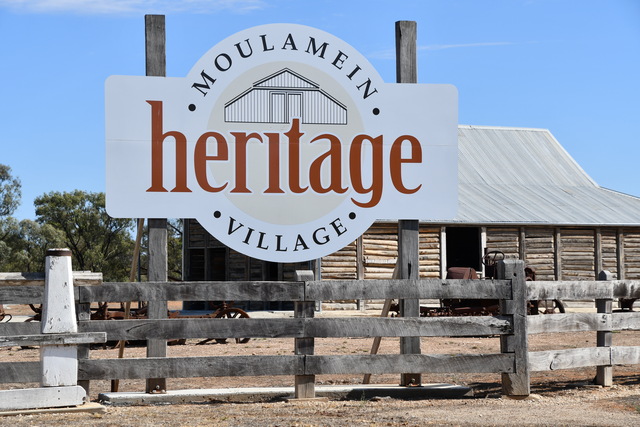
Objecting to Heritage Council executive director Steven Avery’s recommendation that the site be heritage listed, Ms Young said her father was employed at the settlement from 1968, and like many locals, was involved in the initial construction of the tourism attraction.
“My father was employed within the Restoration Department, and was responsible for signwriting, artistry, restoration, gold leaf, painting, lineworks and many other involved tasks,” Ms Young wrote.
“The successes of the settlement has always been aligned to local vision and involvement coming from passion and a desire to see the settlement succeed both economically and socially.
“I am disappointed that the views of the local community originally involved in the establishment of the settlement and their families appear to not have been given the degree of importance they deserve.”
Responding to Criterian A of the recommendation that the Pioneer Settlement has an importance to the course or pattern of Victoria’s Cultural History, Ms Young said the importance of the Pioneer Settlement as a local historical site rather than a state one can be found in a statement made by the late Ross Mellor in his President’s Report for the Swan Hill Folk Museum Annual Report:
“We began in this year to work with a Museum which has become a living entity – the growth pattern and demands requiring ‘planning on site’ where full play was allowed for the stimulating interaction of ideas and arguments, between our architects, committee members, staff and vitally interested patrons.
“All of these people took a collective and ownership interest in what we are trying to do.
“To our staff – a group of people who have helped build this museum, not only in the various departments, but in their interested attitude to our patrons, each one of them, irrespective of their responsibility, know that they form part of the team and that their views are welcomed on many aspects of the Museum development.
“Each employee is a curator in his own field.
“He knows basically, how we began and what we are trying to do.”
Ms Young said that these statements, which emphasise local knowledge and involvement, should be seen as more important than that of paid outside advisors.
(The Pioneer Settlement was originally the Swan Hill Folk Museum).
In Criterian H, which asks for ‘special association with the life or works of a person or a group of persons of importance in Victoria’s history’, Ms Young said the contributions of advisors Roy Grounds, Robert Ingpen and Eric Westbrook, who were named in the Criterian, “should not be valued over local associations/people who were the main drivers and initiatiors of the whole concept and development”.
“The settlement does not reflect the involvement of these people in areas of signifance but reflects the community involvement, passion and drive.”
The Swan Hill Rural City Council has also opposed the heritage listing, largely as it does not meet the three criteria as recommended by staff of Heritage Victoria.
This view of council has been supported by expert heritage architectural firm Lovell Chen.
The result of Heritage Registration may be to significantly restrict the maintenance and day-to-day activities that would occur at the Pioneer Settlement.
“If the recommendation is adopted as per the recommendation by officers of Heritage Victoria, the whole of the Pioneer Settlement will be subject to Heritage Registration conditions,” council stated.
“Exemptions can be granted by Heritage Victoria upon written request, which are likely but are not guaranteed, and may apply to some of the modern infrastructure on the site as well.
“These restrictions may result in delays and significant costs in carrying out maintenance and renewal works at the site.
“Ultimately, the infrastructure, whether old or new may subject to the conditions of the Heritage Registration and Legislation.”
On the Pioneer Settlement grounds is the Heartbeat of the Murray, a modern laser light show, which is recommended to be considered part of Victoria’s state heritage.
In her submission, Ms Young said that the involvement of Heartbeat of the Murray would not fulfil Criterian F – the importance in demonstrating a high degree of creative or technical achievement at a particular period.
The Guardian reached out to Heritage Victoria for comment about whether executive director Steven Avery visited the Pioneer Settlement and Heartbeat of the Murray in person prior to giving the recommendation that it be put on the Register.
Heritage Victoria wrote back that an officer did an on-site review, but not Mr Avery – Mr Avery had previously visited the site, but it was in a personal capacity, not in his role of executive director.
The Pioneer Settlement is currently run by the Swan Hill Council and is subsidised between $700,000 to $1 million per year to operate and maintain, with much of this cost coming from ratepayers, Ms Young writes.
“This listing puts at risk the future of the settlement, including $10m funding for the establishment of Our Place and $450,000 for a new Heartbeat of the Murray show, because Heritage Victoria may not align to community preference to attract more visitors to the region, along with lessening the contribution from ratepayers to keep the settlement open and operational.”
In a statement to The Guardian, the council said it was important to note that any new developments, including Our Place, would not be considered by the Heritage Council as part of the proposal to register the Pioneer Settlement on the State Heritage Register, and that the existing art gallery, Spoons Riverside and school lodges are outside the proposed registration area.
“Council considers that the majority of the community is excited that Our Place will be a sophisticated and progressive building that contributes to and reflects the city’s progress and growth, whilst respecting our past.
“The building is for our future generations.”
Those interested in witnessing hearing proceedings can register their interest via the Heritage Council’s website: https://heritagecouncil.vic.gov.au/