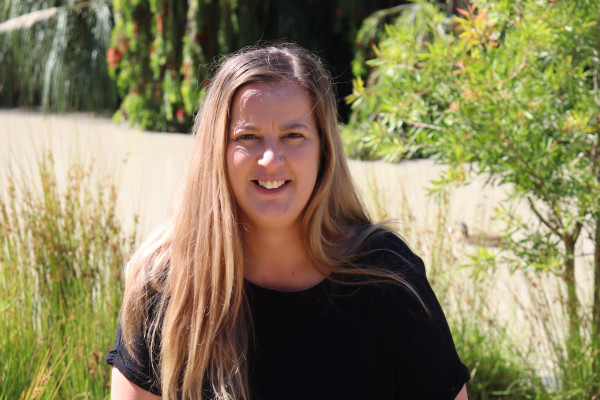
WITNESSING a child being taken into foster care was enough for Danae Coote to want to make positive changes to children’s lives.
“It really upset me because I had a close relationship with this child,” the Swan Hill child protection practitioner said.
“It was only because they didn’t have family members in the community as to why he was going into foster care … he had a very sick sister.
“It was quite upsetting and I just thought I want to make that transition a bit better for children.”
The Mallee, including Swan Hill, has been identified by the Department of Families, Fairness and Housing as a priority area to secure more child protection workers.
The push to boost the local workforce is part of the new Victorian Government’s Go Where You’re Needed campaign, which called on new graduates and career changers to consider joining the workforce and help keep children safe.
The campaign aims to recruit more than 280 new child protection practitioners across metropolitan and regional Victoria.
Ms Coote began working in childcare when she was just 16 thanks to a school program.
After witnessing the “most heartbreaking thing she’d ever seen”, she went on to complete a Diploma of Community Services.
At the time, Ms Coote was raising a newborn as a single mum, working part-time and lived with dyslexic.
She completed her first six-week placement at Mallee District Aboriginal Service (MDAS) in Swan Hill, where she worked in the family services role for three years while completing her study.
She then transitioned to the role of team leader of out-of-home care and case contracting where she had direct contact with child protection staff.
In her current role as case contracting co-ordinator, Ms Coote worked closely with external services including MDAS, Mallee Family Care and Catholic Care.
“I work collaboratively with external services who do the day-to-day case management and we sit with the legal obligations,” she said.
“It’s a really great space because I get to work with other service providers in town just to ensure we are giving the best possible program delivery.
“So the Aboriginal children sit with MDAS, and that’s really amazing to get the cultural learnings on case management of these clients – it’s a really great positive.”
Ms Coote said the career was rewarding, despite “having your days”.
“I think you definitely see positive outcomes with families and children,” she said.
“It can be an awesome feeling that you have helped preserve a family and maintained that family.”
Keeping a family unit together was the main goal, Ms Coote said.
“That reunification is the goal … we go out with the intention not to place children out of parental care, but to go and support and put in place measures to ensure they stay as a family unit and make those positive changes to ensure children are safe.
“I go into not to use the term ‘better parenting’ but to upskill the parents.
“Everyone comes from different backgrounds and what they know as normal might not be at a level of acceptance.
“So to go in and work with parents to get them to understand what risks to children are, whether exposed to family violence or substance abuse, and the importance of knowing behind that what impact it has on a child and their development.”
Ms Coote said the “holistic” approach was important, especially when referring families to services.
“Just because you have an argument with your partner, it impacts the children,” she said.
“To go in and refer to services, we work with families on that, but also refer to services like Mallee Domestic Violence Services to work with specialists there – get a clear understanding and whole holistic approach of what happens in domestic violence relationships.
“There is definitely no text book to parenting and it’s case-by-case, and sometimes child-by-child.
“It’s individual work; you may have the mother engaged and get positive outcomes, however the father might not want to engage.”
Ms Coote said COVID-19 restrictions made her work more challenging, especially around mask wearing.
“We prioritise the higher risk clients so getting out and visiting as often as possible, but also wearing a mask meant not making a relationship with a smile,” she said.
“When child protection knocks on the front door it can be overwhelming and scary, so not being able to engage with facial expression, just with your eyes, didn’t help either.”
Ms Coote said her team had recently enjoyed positive outcomes.
“We go as far as celebrating in the office,” she said.
“We think, ‘A child has gone home, how amazing is that’.
“We acknowledge what parents have done to make that happen and the changes they’ve made.
“We’ve had positive cases of children going home just before Christmas.
“A lot of people probably think we celebrate coming in and removing children, but that’s definitely not the case.
“We celebrate when kids get to go home.”
Strong support from local police meant Ms Coote didn’t need to be concerned about her own safety in the community.
“That was one of my really big worries, because I’m a single mum, live on the main road and take my daughter to the supermarket, I thought I would be worried if I saw a client at the supermarket, but no, in the two years there have been no incidents in the community like that,” she said.
“There is so much support in the office and we have a good relationship with police who are supportive of us as well.”