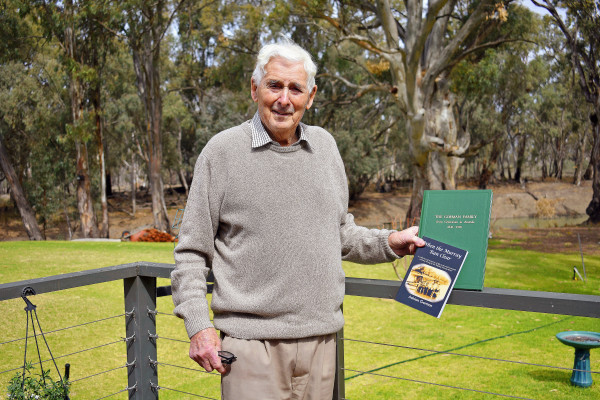
RESPECTED Balranald local Adrian John Gorman OAM was known as an “ideas man” being a farmer, author, sculptor, and the chairman for 23 local organisations.
His involvement in several community groups and organisations included being a founder of the Abercrombie Pumping Association, being the deputy chair of Balranald Inc, a member of the Growing Business, Industry and Tourism Advisory Committee, and chairman of the Balranald Heritage Trail Project Committee.
Mr Gorman died aged 96 – six months after his contributions to the small town were recognised with a prestigious Order of Australia Medal.
Born in Melbourne on September 2, 1927, Mr Gorman was raised at Meilman Euston.
His book When the Murray Ran Clear detailed his childhood in Meilman and his life until his marriage to Patricia Gorman in 1954. They were together for 70 years until Patricia’s death in June.
Eight weeks later Mr Gorman’s family returned to St Dympnas Catholic Church in Balranald to say their goodbyes.
Mr Gorman’s son Simon Gorman – who is one of eight children – told friends and family of his love and dedication for his late mother.
“So many have remarked that dad could not live without her,” Simon said.
“That may be true, but we think they both might have enjoyed at least a longer rest apart from each other.”
“Dad remarked in his last days that when he died it might be hard to find her in heaven given the number of people crammed in. I myself have no doubt that if heaven exists, Mum will be waiting near the gate to yell ‘Adrian’ and to critique the clothes we sent him in.”
Mr Gorman’s reputation as an “ideas man” extended to the care of his wife.
“At one period when mum was in her late 80s and dad in his early 90s – she fell into the rose garden at Willowvale,” Simon said.
“Dad could not pull her up to a standing position. So in typical dad fashion he fetched the old metal fridge trolley and manoeuvred mum onto it – in much the same way that Hannibal Lecter was bound and transported in Silence of the Lambs.”
Fortunately, Mr Gorman’s son Terry Gorman was there to pull the couple out of the situation.
“Terry turned up a little later to find dad tethering the car up to the trolley using a long rubber hose as a rope to pull mum out of the garden,” Simon said.
After moving from Meilman in 1950, Mr Gorman purchased Willow Vale Farm with his brother Michael.
His son Terry gradually take on farm responsibilities later in life.
“I came home from university in 1981 to work with dad on the farm, which was an interesting time,” Terry said.
“We had a strained relationship but I think that happened with many fathers and sons working together.
“But he did give me a lot of responsibility straight away, as he thought bowls was a better option to mustering or ploughing.”
Mr Gorman saw the potential for irrigation from the Murrumbidgee River and in 1959, called all landowners between Hay and Balranald to discuss pumping water from the Murrumbidgee River to the Hay Plains.
After years of persistence, the Abercrombie Pumping Scheme was built.
“It pumped water for the first time in 1967 and provided irrigation to 15 properties, and stock and domestic water to approximately 400,000 acres between Hay, Moulmein, and Balranald,” Terry said.
“It is a very successful scheme that still operates today.
“For the whole time he was farming on Willow Vale, he tried to get access to Lowbidgee floodplain water, never wavering in his belief that he was entitled to it.
“It kept his mind active and he was in a constant battle with the Water Commission for over 50 years.”
Terry added that his father enjoyed a variety of sports and joined local clubs to play bowls, tennis, cricket and golf.
“He discovered bowls in about 1980 and he was hooked,” he said.
“For the next 40 years he played, umpired, coached and talked bowls continuously. He won just about every competition around at some stage. He encouraged everybody he met that they should play bowls.”
In the 80s, Mr Gorman developed a love for travel after visiting his son Bill in America.
Over the next 35 years, he would travel all over the world.
Simon recalls his dad visiting him when he lived in Rwanda, where he accompanied him through an overcrowded jail full of 6000 Hutu prisoners.
“(They were) all murderers whom had participated in the genocide,” Simon said.
“He accompanied with an unbridled curiosity where many would have refused to go.
“On that trip we stayed in budget hotels across Uganda and Kenya and the living conditions were a little rough. You don’t get much for $5 per night.
“Not once did dad complain despite being bitten by all manners of insects and dining on some pretty dodgy food.”
Simon added that some of his dad’s eccentric ideas were inspired by his travels, including the idea to build a grotto at St Dympnas Church after coming back from Italy.
“It was a motley structure of many trailer loads of used bricks, old concrete – limited cement, and every type of farming wire, which was deficient in its design and completely lacking in structural integrity,” Simon recalled.
“He was incensed when the council rightly condemned it and ordered its removal.”
Mr Gorman had 28 grandchildren and 21 great grandchildren who enjoyed his help and company.
“My brother-in-law Des Callan this week reminded me of dad meeting their son Noah who has cerebral palsy quadriplegia,” Simon said.
“Dad, after meeting Noah, proceeded to sketch up an inflatable suit with solenoid valves and tubes that he thought might help Noah become mobile.
“While like many of dad’s inventions like his blow up suit did not make it past the sketch or prototype stage, it did encapsulate both his compassion and ever present desire to use his mind.”
Mr Gorman OAM died peacefully at Deborah Cheetham Retirement Village, Ocean Grove, aged 96 years old, on August 14.
He was buried beside his wife Patricia at St Dympnas Catholic Church Church at Balranald.