STUDENTS at Swan Hill Specialist School have been kept busy with sporting endeavors, showing off their skills in the swimming pool and on the running track in recent weeks.
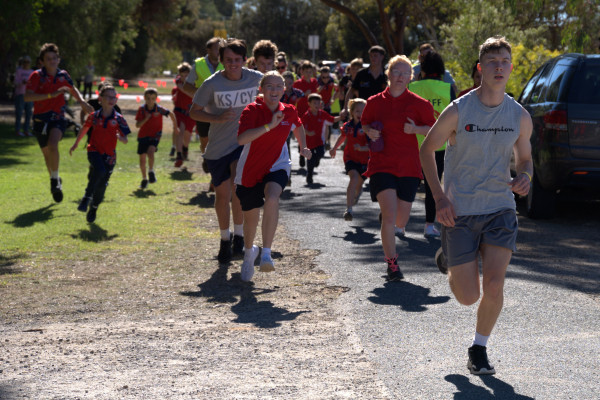
Students and teachers pulled on their running shoes on Tuesday morning as the school held its annual cross-country run, with students running or walking between one and two kilometres.
The students were full of smiles as they gave their all while racing one another on the run and trying to qualify for the school’s regional cross-country team.
Swan Hill Specialist School physical education teacher Virginia Allen said sport was a great way to build school spirit within the students.
“I run four weeks of training in PE class in the lead-up to the cross-country so the kids are prepared and know exactly what to expect which is very important for our students.
“Every student receives a certificate for their participation but the fastest students win a medal.
“I always tell the students that if they’ve missed out on a medal, they shouldn’t be disappointed if they tried their best.
“Maybe next year they can be a little fitter or try a little bit harder, which just creates that seed of success.
“I really like that we are following those school sporting Victoria pathways, because it means that the students can achieve at the highest level.
“With that, even with our cross-country at regional and state levels, it really builds engagement with the students who want to be a part of a team and go away to represent the school.”
The school’s cross-country quickly followed the school’s success at the SSV state swimming championships last month, with students bringing home two medals for their efforts.
Five students travelled to Melbourne’s Sports and Acquatic Centre in April, with Claire Thompson-Banes finishing second in the 15-16 girls’ 50-metre multiclass backstroke.
Darryl Michaels also claimed a silver medal for his performance in the 17-20 boy’s 5- metre multiclass freestyle.
Ms Allen said the competition was even more fierce after a change in SSV’s multiclass classification.
“The standards were high and the races were full and our school were still able to bring home two medals on the day,” she said.
“Multiclass swimming used to need to have a intellectual disability or a physical disability, and you were sort of assessed.
“Now, I think this year was the first or second year of this, but autism is being recognised as a multiclass disability.
“That meant that every race was full of swimmers, and from my perspective the numbers were much higher, which I think stemmed from the inclusion of autism in multiclass.”