SWAN Hill Primary School is proud of its science program which is designed to give children lots of hands-on learning in a fun and safe environment.
Teacher Penee Laughlin said students were much more engaged and eager to learn when they were able to get involved and explore for themselves.
“Wherever possible, we try to create hands-on learning because it suits all students,” she said.
“It doesn’t rely strictly on literacy or numeracy skills and can also benefit children who have English as a second language.
“Generally speaking, the kids just love learning through hands-on and we find the engagement levels are great.
“Science gives everyone the chance to explore the concepts behind things in our world on a deeper level.
“Students get to work together in groups and communicate and negotiate to problem solve in a flexible learning environment.
As part of the science program, the school is currently focused on water and air.
Learnings are catered to suit the different age groups with age-appropriate activities and information.
For example, students in grade prep and 1 have been learning about air and water through bubble blowing and making their own parachutes from garbage bags.
The grade 4 and 5 students have been looking at water cycles and experimented with making clouds in jars to explore condensation and how clouds are formed.
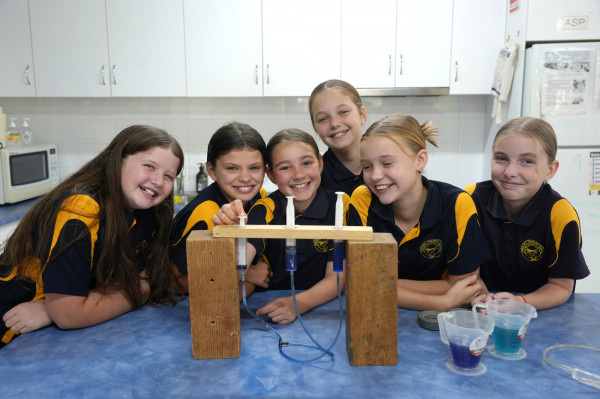
Other students have been studying hydraulics and pressures applied to confined water to create movement.
They have been experimenting with home-made hydraulic systems using water and weights to demonstrate how water can lift weight.
The school changes its focus to a new theme three times per term and next students will be learning about space and the solar system.
Grade 6 students will continue their studies in robotics.
There are two teachers in the science program, and each has their own area they are most passionate about.
“Bruce Stevens enjoys mechanical and physics topics while I really enjoy biology and incorporating natural science,” Mrs Laughlin said.
“This allows for us to explore outside which the children really enjoy.”
Other science themes have included electricity and solar power where students learnt how to create an electrical circuit.
Grade 5 students had the chance to work with a solar car kit which they got to keep, and the grade 6 students made solar powered boats which they raced.
Mrs Laughlin said the school was also registered as a donation recipient as part of their commitment to sustainability.
This means families who recycle containers that are eligible for a credit, can donate those credits to the school, with all funds going directly to the purchase of more science supplies.
An example of these products are bottles, cans and juice containers and can be dropped off at a Visy recycling facility.
To find out more about how you can donate your recycling refunds, visit the school’s Facebook page or download the Container Deposit Scheme (CDS) app.