THE ancient history embodied by Lake Mungo’s fossilised footprints will be on display inside an inflatable planetarium dome in Balranald this week.
Balranald’s Theatre Royal will host the free event from 9am until 12:30pm on October 6, with visitors invited to take in the immersive media experience.
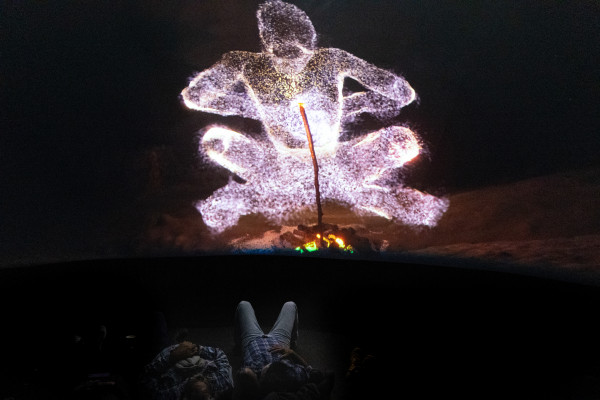
The screening will show an excerpt titled “The Lake Mungo Story,” which comes from The Earth Above: A Deep Time View of Australia’s Epic History.
The feature length planetarium show has been produced by Deakin University’s Motion Lab for Australian Research Council Centre of Excellence for Australian Biodiversity and Heritage.
Before the full film is shown in existing planetariums across the nation and internationally, the creators are travelling to show excerpts on Country with the communities involved in its production.
Deakin University senior film lecturer Dr Martin Potter said the film looks into the relationship between modern archaeology and ancient Australian history.
“This film explores the entanglement of emerging archaeology and indigenous knowledge across a variety of different sites around Australia,” he said.
“One of those sites is Lake Mungo, which has an incredible cultural history and a really interesting relationship between traditional owners and archaeology.
“We have been collaborating with the Lake Willandra First Nations consultative group on developing a story around the trackways there.
“The trackways are these fossilised footprints that were exposed by the West winds blowing away a layer of sand 20 years ago, and actually found by one of the people featured in this film, Mary Pappin Jr.
“It’s amazing to me that there’s incredible historical stories there being uncovered and being reconnected with people.”
Dr Potter said that it had been “fantastic” to work with the First Nations consultant group.
“We were guided by the First Nations Consultant Group to look at the trackways as a story that they wanted to see going out more into the world and expand the general public’s understanding of the stories at Lake Mungo,” he said.
“We’ve taken that story and tried to figure out a way to create a really beautiful, immersive animation where you can travel back in time and see a moment of a story hypothesised by the Paakantji people that came to read the tracks.
“I think that the more people we’re able to get this kind of story out to, the better.
“Our civilisations are more ancient than most, but the traces are so small and different to settler colonial eyes.
“It’s really interesting to open our eyes to this kind of very hard to see history.”
Both the style of animation and the way the film is shown makes use of contemporary technology to tell stories of ancient times.
Dr Potter said it was something the team may not have been able to achieve just a decade ago.
“I love that we’ve got something that is an ancient story, over 20,000 years old, combined with cutting edge technology,” he said.
“I think that the way that works can be really effective in terms of how it impacts people. It really draws people in when you feel like you’re travelling.
“It’s like travelling through time and that’s really wound into you because you feel you’re in this futuristic space and then you’re being transported back into this very different landscape.
“I think that’s really exciting, being able to inspire that sense of wonder for people and to have this technology become more and more accessible.”