THERE is a remarkable number of artworks on display at the gallery. Ninety-one, to be precise.
These were chosen from the permanent collection, a collection of more than 550 paintings, drawings and prints, a small number of sculptural works and a handful of photographs.
From the early years, the direction of the gallery’s collection was to follow the emerging interest in Australian naive art and subsequently Australian prints and drawings. In broad terms, naive art refers to artworks produced by artists with no formal training.
Naive art can also be characterised by a raw approach with art materials and technique, artists sometimes using house paints and other crude materials. The images indicate an artist’s limited understanding of depth, perspective and spatial awareness.
Typically, the artists are not interested in particular concepts, art movements, political commentary or trends.
They are painting to tell the stories they know so well, the stories of their own lives, their immediate surroundings, the nine to five, and the everyday.
As such, many naive artists have taken up painting only at the end of their working lives.
The late Sam Byrne, of Broken Hill, began painting after he retired from a life as a miner, farm labourer and rabbit trapper.
His paintings speak honestly of his life in the outback. Another, Selby Warren, began to paint in his eighties.
Over the years, the gallery has broadened its collection policy to include works on paper, prints and drawings.
The well recognised Swan Hill Print and Drawing Awards, established in the 1980s, continue to attract some of the most accomplished artists from across the country.
As the collection grows and more artists represented, the story of Australian printmaking and drawing becomes ever more comprehensive.
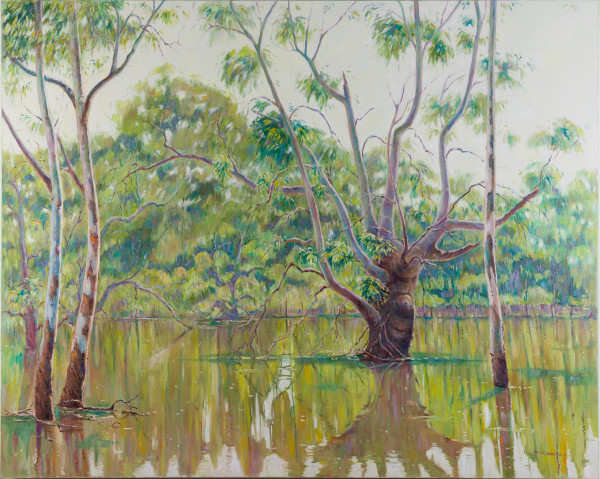
Some of the highlights to look out for when visiting the gallery include: Julie Chislett-Duffus’ immersive painting Vinifera Forest Floodwaters, Aunty Lucy Connelly’s pyrograhic work Grandpa and Grandma’s Kitchen, David Frazer’s Slow Boat, a magnificent lino print alluding to the human condition and landscape, Sir Russell Drysdale’s The Drovers, a pen and wash study, Martin King’s award winning comment on the environment once willing NOT NOW, and Melbourne artist Wayne Viney’s series of monotypes on Lake Charm.