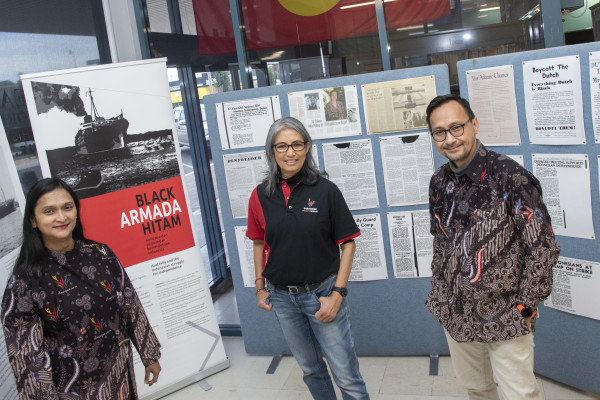
A LITTLE-known piece of Australian and Indonesian history went on display last Saturday and will remain on show at the Swan Hill Regional Library until May 14.
The display explores Australia’s strong connection to the Indonesian independence movement following the World War II as the fledgling nation broke ties with its Dutch colonial masters.
It has been curated by the Indonesian Diaspora Network VIC (IDN VIC), an organisation for Indonesian citizens who no longer live in their homeland or who have Indonesian heritage.
The exhibition having toured locations such as Indonesia, the Immigration Museum in Melbourne and other regional centers, it is now Swan Hill’s turn to play host.
Jeffry Liando from IDN VIC said the exhibition showed the good relationship the Australian Government and the Australian people (especially trade unions) had at that time with the Indonesian people as they helped Indonesia to gain independence from the Dutch.
“The port unions black-banned Dutch ships, including naval vessels, in Perth, Melbourne, Sydney and Brisbane, not allowing them to leave,” Mr Liando said.
“As well as a campaign to not buy from or sell to the Dutch, the ships stuck became known as the ‘black armada’.
“This is an excellent example of how the Australian and Indonesian people work together”.
The organisation’s Diana Pratwi said there was a movement to resist any recolonisation by the Japanese, Dutch or English after World War II and the Australian people supported this.
“The Dutch tried to go back there and recolonise so the unions stopped all the Dutch navy ships and ships with ammunition and guns leaving Australia,” Ms Pratwi said.
“It became a catalyst for an international movement with people from India, China and other countries to support Indonesian independence.
“Australia was the first foreign country to send an envoy to Jakarta to welcome the proclamation.”
There is also a local connection, with eight Catalina seaplanes from the Royal Australian Air Force, some of which might have been based at Lake Boga, having been sold to the fledgling Indonesian Airlines (later to become Garuda Indonesia) for use by the independence movement.