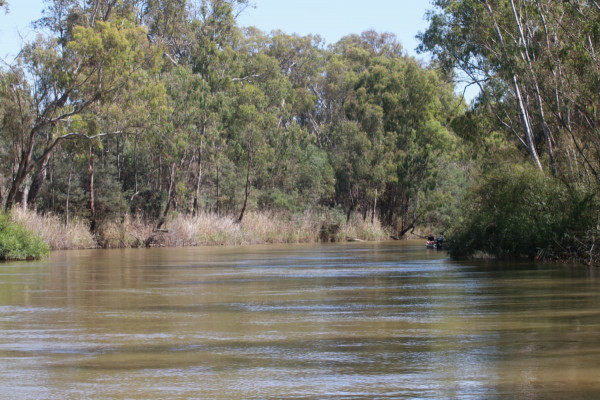
THE Murray-Darling Basin Authority (MDBA) says there is no “silver bullet” solution to the “sand slug” problem impacting the Barmah Choke on the Murray River.
Director of river management Ben Dyer said the MDBA was working with the community, seeking expert advice and “finding a way forward”.
“Earlier this year we shared research that revealed a surprising cause of decreasing capacity in the Barmah Choke was a massive sand slug that experts believe has been mobilised largely by land use and mining change in the 1800s,” Dr Dyer said.
The report estimated more than three million tonnes of sand had settled in the Barmah Choke, the river’s narrowest stretch, reducing its capacity by 20 per cent over the past 40 years.
Nearby landholders have long claimed the choke’s capacity issues are due to bank erosion caused by the river running high.
It was a point of contention during the recent drought that Murray River irrigators frequently had a zero general- security water allocation.
“Over the last year we have continued to collect and analyse data so we can better understand the sand slug, how it is moving, and the impact on the Barmah-Millewa Forest,” Dr Dyer said.
“We measured the depth of sand on the riverbed between Yarrawonga and Barmah and found that there is more than 20 million cubic metres of coarse sand in this reach – enough to fill the MCG 13 times.
“The sand is moving slowly downstream and into the reach of river where it flows through the Barmah-Millewa Forest.
“The Barmah-Millewa reach is quite unusual in that water flows out of it, through creeks and flood runners, instead of into it, like most other river systems.
“It is a low-energy reach and the land is quite flat.
“The sand is coarse and heavy and even in high flows, such as a flood, the sand only moves along the bed of the river. “This means that when the water flows out into the forest it leaves the sand behind, gradually filling the river channel.”
Dr Dyer said the sand was “accelerating” erosion of the riverbanks, filling the deep pools, covering up snags and reducing the capacity of the river.
“If we do nothing to manage the sand this damage will continue,” he warned.
Dr Dyer said there was a “significant” commitment from basin governments and the MDBA to work with locals to find solutions.
“We’re confident there’s no silver-bullet solution to this problem,” he said.
“Instead, a multi-pronged approach looks to be the most promising option, including protecting key sections of riverbanks, removing sand in targeted areas, and moving water around the reach to reduce summer and autumn flow rates.
“These all need to be investigated further to determine how, when and where each of these options could be applied.
“Finding solutions to address the sand slug is part of our broader work program to address potential shortfall and capacity issues including through the Barmah Choke feasibility study.”
Dr Dyer said consultation would continue with First Nations, irrigators, local government, state water authorities, national parks representatives and environmental agencies about the problem and the possible solutions.
“We’ll continue to engage with the people who, like us, are fighting to preserve this amazing stretch of river,” he said.
Later this year, the MDBA will submit findings and options to basin governments for further work.
‘Collapsing the system’
WAKOOL River Association chairman and Tullakool farmer John Lolicato says the answer to the Barmah Choke “sand slug” is to restrict downstream development requiring irrigation.
“The MDBA is clutching at straws and doesn’t want to acknowledge that there’s a natural constraint stopping large volumes of water from flowing down the river,” he said.
“This whole exercise seems to revolve around trying to find some way to justify putting in something that will allow water to bypass the choke.”
Mr Lolicato said developers couldn’t continue demanding more water downstream.
“It’s collapsing the system and collapsing societies,” he said.
“If you want to develop, it has to be upstream.”