UNDER “business as usual”, without any new pledges, the world would warm up by 2.7 degree Celsius this century, according to the Climate Action Tracker.
Even the array of new national pledges made in Glasgow over the last fortnight’s UN Climate Change Conference would lead to around 2.4 degrees of global warming this century – far from a safe level.
For Swan Hill, and the region more broadly, this could involve longer and more severe droughts, extreme heat, intense episodes of flooding, crop failures and an increase in heat related illnesses as well as mosquito-borne viruses.
According to the Australian Conservation Foundation, if more action isn’t taken to prevent climate damage the average daily maximum in Swan Hill is projected to be 26.1 up from 22.9 degrees between 1960 and 1990.
This would effectively mean no real winter and around half the year made up of summer or “high summer” weather.
Extreme summer temperatures may be 4.5 degrees hotter than the 1960-1990 summer average with 28 per cent less rain on average than that period.
There will be up to 122 days over 30 degrees, including up to 23 days over 40.
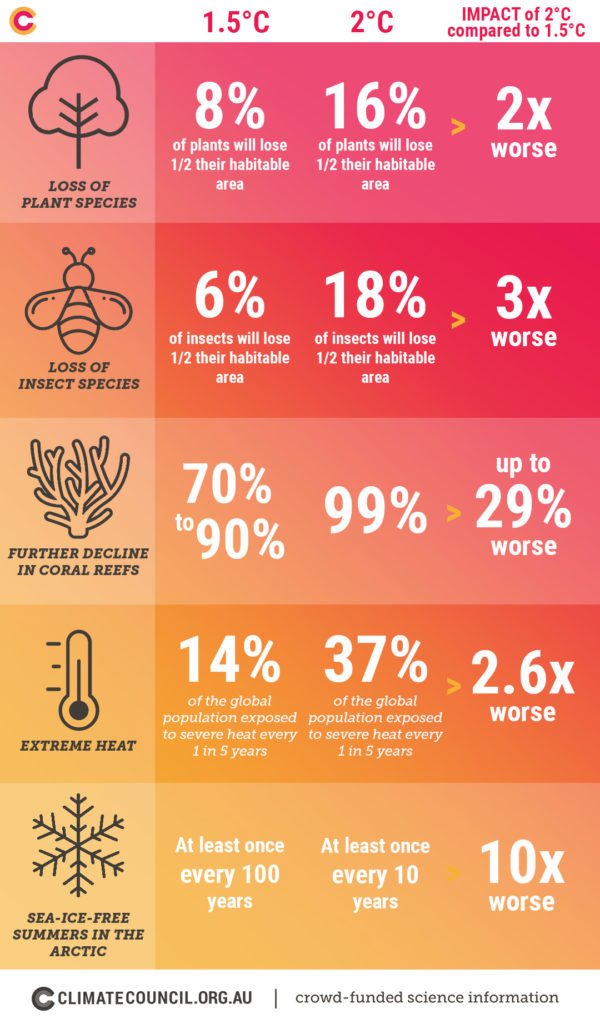
At 1.5 degrees increase, which the planet is predicted to reach within the next decade, The Climate Council explained that eight per cent of plants will lose half their habitable area and coral reefs will have decreased 70 to 90 per cent.
By 2 degrees, there will be twice the impact on plants, three times worse loss of insect species and extreme heat will be 2.6 worse than at 1.5 degrees with 37 per cent of global population exposed to severe heat every one in five years.
This evidently has the potential to impact one of the key industries in the region – agriculture – with 62 per cent of the Mallee under agricultural production including 1.3 million hectares of cereals, pulses and oilseeds.
The region is also the leading producer of Australia’s almonds, olives, table and dried grapes, as well as most of Victoria’s melons, avocado and citrus.
Farmers for Climate Action CEO Fiona Davis said farmers wanted to be part of the solution and see the opportunity this presents for their communities.
“However, achieving net zero emissions needs to be a responsibility shared by all economic sectors, in particular transport and energy,” Dr Davis said.
“Let’s remember we can’t kick the can down the road and draw down emissions on the eve of 2050.
“We need to urgently make deep emissions cuts before 2030.
“This is the most important decade to protect farming families.”
Dr Davis said farmers needed a stable climate to continue to produce the food and fibre on which Australia and the world relies.
“Climate change is one of the greatest challenges of our time, but it also presents an incredible opportunity for Australia, thanks to our ample sun and wind, and our long history of innovation.
“It’s time for our work together across our communities to ensure we don’t just survive but thrive into the future.
“Farmers for Climate Action looks forward to seeing more details and the modelling of Australia’s plan to reach net zero emissions by 2050.”
FCA is reminding the Federal Government that while agriculture’s methane emissions are falling, methane emissions from fossil fuels are rising due to an expansion of the natural gas industry.
Its comments come amid news Australia will not support the proposed 30 per cent methane reduction pledge at the Glasgow climate summit.
“Australia could support a 30 per cent methane reduction commitment if it were willing to support methane emission reductions in the gas industry,” Dr Davis said.
“Agriculture recognises that methane reduction strategies, if adopted at scale, support productivity improvements and growth in our livestock industry.
“We’ve led, now it’s time for the gas industry to catch up.
“Our message to the Federal Government is don’t throw cows under the bus.
“The gas industry must not come before Australian farming families.”