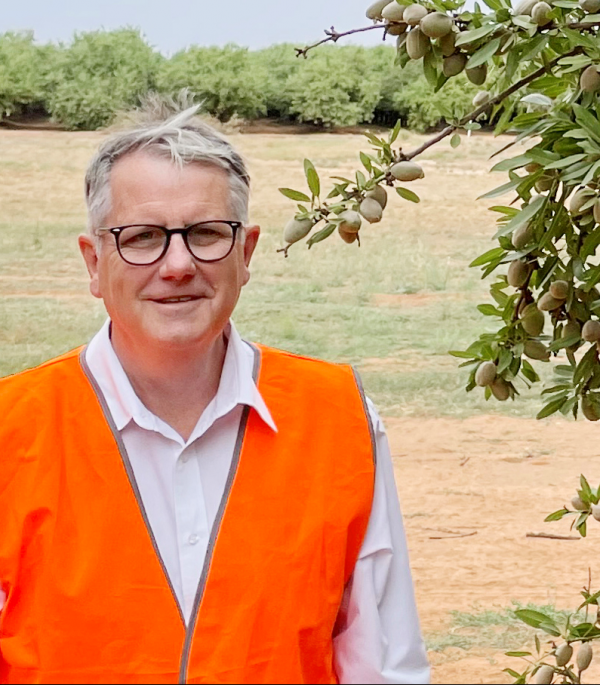
ALMOND producer Select Harvests says its Piangil orchard generated much of the increase to a record tonnage in the 2021 financial year.
The company’s 2021 annual general meeting was told production rose to 28,250 tonnes as young trees begin to increase yields above business case expectations.
Select Harvests, which has orchards in north-west Victoria, southern New South Wales and South Australia, said the company could now confirm its confidence in the Piangil investment just over a year ago with a 20 per cent increased crop area.
Managing director Paul Thompson said that while the almond market had been challenging over the past two years due to a combination of record crops in Australia and California, supply chain disruption and channel-switching during lockdowns, more buyers were now re-entering the market.
“Globally there are positive signs of increased demand in the away-from-home and food services sectors, consistent with people moving out of lockdowns and public activity rebuilding,” he said.
Mr Thompson said that while this season’s crop had been grown in wetter than normal conditions, the isolated, unseasonably heavy rains across some growing regions, for the most part, had little effect.
“With normal conditions and accounting for our improved maturity profile, we estimate our 2022 crop to be higher than last year, at 29,500 tonnes,” he said.
“Lower prices have increased opportunities for almond consumption in both the snacking and ingredient markets.
“Fortunately, we have been able to get our seasonal labour in place to support our harvest during the operational peak.
“Almond buyers are paying a premium for high-quality, in-shell, larger sizes, and prompt delivery.
“We have sold more than 20 per cent of the 2022 crop into export markets.
“We are focused on Asian markets where we do not need transhipment through currently congested ports like Singapore.”
Mr Thompson said the company’s largest uncontrollable cost had historically been water, with temporary water prices reaching highs of $700 a megalitre in the 2020 financial year to now, when temporary water was trading for less than $100 a megalitre.
“Lower water costs will flow into the 2022 financial year, with estimated savings of $6 million to $8 million,” he said.
“I am sure that you would be aware of the recent dramatic increase in the horticultural input cash costs for fuel, fertiliser, herbicides and weed control products.
“Fortunately, these costs have not impacted our 2022 crop, and assuming we hit our volume target, our cost per kilogram will be close to last year.”