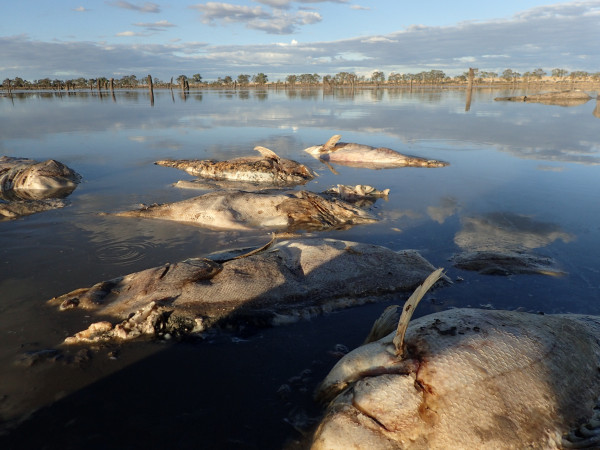
“YOU can’t undo a mess,” Robert Loats says. “I just wish they had have listened.”
Mr Loats, chair of Victorian recreational fishing peak body VR Fish, has voiced his concerns after seeing a number of dead fish at Third Reedy Lake, near Kerang, as it drains and dries up as part of a project to recover environmental water.
“I said under no circumstances try and drain it in the summer, otherwise you’ll have a heap of dead cod and you’ll have a big public outcry,” Mr Loats said.
“Well, look what has happened. I told you so.”
The Third Reedy Lake Bypass Project is part of the Goulburn-Murray Water (GMW) Connections Project, which is focused on infrastructure upgrades to recover water for the environment to enhance rivers and wetlands.
Executive manager of operations for GMW efficiency projects, John Davison, said Third Reedy Lake was one of a number investigated as part of the GMW Connections Project for its potential to return to a “more natural regime” of a wetting-drying system.
“Effectively what’s happened is that the lake has been taken out of use as an irrigation facility, and the decision around what is the best habitat that that lake could become has sort of been debated over a period of time,” Mr Davison said.
“The best outcome according to our experts is that that lake should be returned to its natural state, and to once again become a freshwater marsh that can support other types of wildlife in the district, so water birds and native vegetation would benefit greatly from a project like this.”
Andrew Ash of Swan Hill Hunter Marine Boat Builders said he and two sons had been out to the lake for a look, and saw a dozen Murray cod over a metre long that were dead, as well as quite a few other fish that had died.
Mr Ash, with Mr Loats, attended a meeting in Kerang about the project sometime last year and raised queries.
“We said, ‘Well, what are you going to do with water you save’, and they said ‘well we are going to give to the environmental water holder’, and we said ‘OK, well why don’t you put it in Reedy Lake?’” Mr Ash said.
“We spend a lot of money trying to look after our native fish, and no one wants to see them being killed.”
However, Mr Davison is adamant that every precaution was taken to ensure the best outcome for the fish in Third Reedy Lake.
“In short, there are a number of approvals from state and federal agencies that we had to obtain in order to deliver this project, and in gaining approvals we have been able to establish through the help of experts a way in which we could minimise as much as possible any loss within the Third Reedy system,” Mr Davison said.
The Third Reedy Lake Bypass Project specialist team devised an exit strategy to try and encourage as many fish as possible to naturally migrate and move out of the lake.
This involved a staged draw-down approach, where water was pushed through the lake at the inlet and drawn down faster at the outlet.
This was staged over three weeks and completed in pulses – three days of draw-down, followed by a week to let it settle, before restarting the draw-down process. Nets and electrofishing were also used at the time to monitor the exit.
Once the draw-down had reached its designated water level, which was around Easter last year, the drying phase began.
Media manager for GMW efficiency projects Kate Kernaghan said that GMW had sought the input and engagement of traditional owners and Victorian recreational fisher groups to hear their worries about the project.
“They said, ‘These are our concerns, we don’t want you to do this in summer’, so we did it at Easter when it was cooler, but the very nature of evaporation kind of works in summer, so for a long time the water kind of sat and took its time to draw down,” Ms Kernaghan said.
“We have been monitoring through January, keeping an eye on things, and then in February we did another fishing translocation exercise around the inlet and outlet and extracting any more fish that we could find as the lake got down to the final inches, and we have had someone there with a drone every couple of days doing grid searches of what’s out there.”
Over the past year, more than 1600 native fish have been rescued and moved to a suitable habitat. About 1200 pest species, mainly carp, have been removed from the system, and two southern purple spotted gudgeon were found and sent to inclusion in a breeding program.
A member of the Third Reedy Lakes bypass projects specialist team said the number of fish that had been rescued was very similar in ratio to what they saw in their pre-draining surveys and the pattern of the data was “still matching up with what we are seeing”.
But even with all this in place, Mr Loats believes lake users should be remunerated for their loss.
“So now I will be asking, basically since they have killed the lake for fishing, I will be requesting as a small compensation offset that they put a brand new boat ramp and fishing jetty on Racecourse Lake, so that we can go and access that lake,” Mr Loats said.
“I really believe they should have left the lake alone – that’s just my opinion.”