THIRTEEN Ministers of Agriculture – permanent and acting – since the turn of the century – must sound alarm bells for Australia’s farmers and everyone connected with the industry.
And Queensland Labor Senator Murray Watt is the recipient of that lucky number in the pantheon of people paraded out by various parties to take care of what is basically an $80 billion portfolio.
Alarm bells because Ministers for Agriculture for the past 22 years are averaging just 1.69 years in the chair – hardly much time to get a grasp on the position and have any kind of impact on the hundreds of thousands of farmers, their families and staff and all their allied industries.
Short of leaving it in a state of perpetual limbo.
But Senator Watt is already going out of his way to make sure farmers can see him as the real deal, even though he has no farming experience.
The lawyer-turned-politician last week told an industry event while he hasn’t ever been a farmer, it was in his blood. Because his father was raised on a dairy farm, and the new Minister grew up listening to farming stories.
And one of his first major announcements has been he is determined to shut down the live sheep trade – which has been a genuine cash cow for the industry for decades.
At the same time, Labor’s greenish leanings have confirmed, in its first days of taking office, it will rip 450 gigalitres out of the Murray Darling, and farmers the length of the Murray can watch the water flow by, on its way to being flushed into the Great Southern Ocean so South Australia doesn’t have to dredge the Murray’s mouth at Goolwa.
Hardly a flying start.
Although he has already flagged he has plans to boost agricultural productivity, move exports further up the value chain and assist the industry “cash in” as it moves towards net zero in the next few years.
Details to come.
But the most immediate challenge he faces is workers.
Because there aren’t any. So few backpackers/seasonal workers are available crops are rotting on the branch and vine. Largescale livestock and cropping enterprises are looking overseas for key management appointments – one business has just appointed a manager from Hungary because no Australian wanted the job; or had the skillset and/or experience to fill it.
One Murray River business which has traditionally used one labour agency is now working through six others in a desperate bid to find the bare minimum of workers it needs.
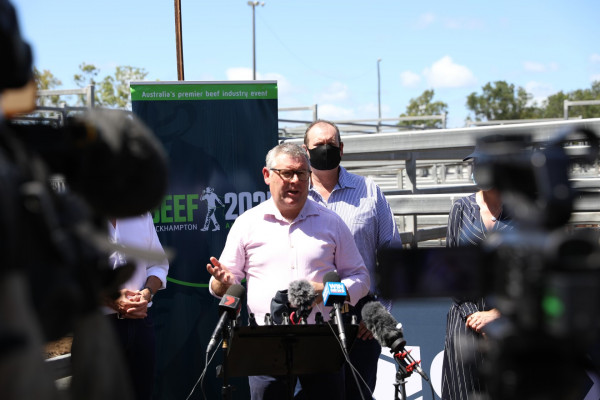
When Senator Watt recently attended Australia’s biggest horticulture trade show it was a chance for thousands of producers grappling with a labour crisis to gather under one roof.
Some pleaded with the new minister to keep the ag visa arrangements brought in by the former government.
Instead, Labor has pledged to replace those arrangements with a system it says offers more incentives to farm workers from Pacific nations.
“If we break election commitments then we get into all sorts of other trouble … I am open to ideas about how we address the problem,” Senator Watt told AAP.
The Senator wants to train Australian workers and expand the Pacific labour scheme.
He says he is willing to investigate a variety of potential solutions, which includes talking to the unions.
“A change of government provides an opportunity to go back to square one with a range of stakeholders.”
Labor’s decision to change the visa arrangements is an unpopular one among some agricultural employers desperate for workers.
Tony Mahar, chief executive of the National Farmers Federation, told AAP the ag visa needs to stay.
“We don’t care what it’s called … we need more foreign workers in here,” he said.
Senator Watt says he’s also committed to phasing out live sheep exports in another move that is divisive in the industry.
“This is something we want to do over time in consultation, in an orderly manner … it’s not going to be done within three years.”
Some producers and exporters are hoping Labor will shift its policy, which it originally took to the 2019 election.
“The policy that was taken to the 2019 election was written at a different time for different circumstances. The industry has undergone significant change,” Scott Kompo-Harms from the Australian Livestock Exporters’ Council said.
“The Prime Minister said it won’t be happening in this term of government which gives us time to try and educate them that it’s a good industry and shouldn’t be banned,” sheep exporter John Hassell said.
Senator Watt said labour shortages, biosecurity and rising input costs are his top three priorities while climate change, sustainability and expanding agriculture has his attention in the longer term.
He has directed his department to engage in energy discussions, although he hasn’t said whether that will mean unlocking more farmland in the pursuit of fossil fuels.
“I haven’t turned my mind to that is my honest answer,” he said.
“What we want to do is seek co-existence between farmers and miners, they are both important industries in regional Australia,” he said.
“We’re certainly not committing to a flat out ban on coal and gas exploration on agricultural land.”
Farming group Lock the Gate wants a ban on coal and gas mining on prime agricultural land, and an end to federal government fossil fuel subsidies
The group’s national coordinator Carmel Flint told AAP the two existing in harmony is a myth.
“The reality is that coal and gas mining has already damaged some of our most productive food-producing land, and planned projects continue to pose an even greater risk,” Ms Flint said.
She encouraged the minister to contact affected farmers to hear their stories.
The new minister knows he has a big job ahead. And he has stated he’s committed to listening to farmers while conceding he doesn’t have all the policy answers just a few weeks into the new job.
SENATOR Watt told Australian Financial Review he is also focused on short-term issues facing farmers, flagging workforce shortages and biosecurity risks (Indonesia is suffering from outbreaks of lumpy skin disease and foot and mouth) as “the two most immediate priorities”.
He said implementing Labor’s election promises for the sector were also a pressing concern – the banning of live exports, and helping primary producers and processers through the energy crisis.
He has also inherited the forestry crisis, as global timber prices surge and a combination of insufficient local production, bushfire damage and import delays result in stalled building projects.
With the caveat that “options for federal intervention were pretty limited” and Australia is still a net importer of timber, he said Labor would invest in new production lines, upgrade mills and expand the plantation estate to help producers “get more out of their resource”.
Even though farming communities traditionally support the Coalition over Labor, Senator Watt believed that people wanted to “move on from some of the fights that dogged regional Australia under the former government”.