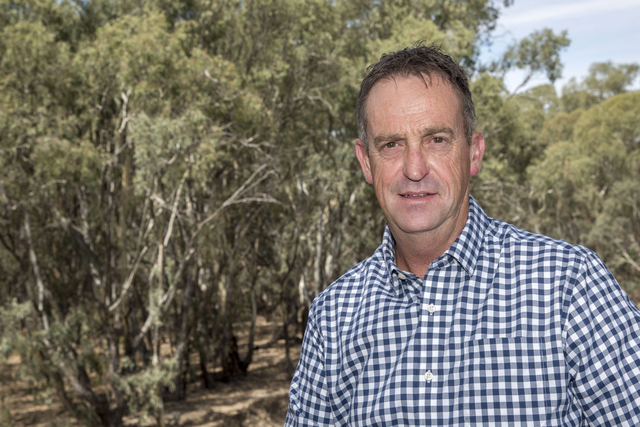
IF Rod Rose had been an English teacher, rather than dabbling in maths, science and PE, he might have had a better grasp of the meaning of retirement and the suggestion it has something to do with having time to put your feet up.
But, after more than 30 years in the blackboard jungle, Mr Rose has chucked the chalk for life as a sheep breeder – and not just as a producer of commercial animals.
Instead, because he wants go flat out, he has launched Rosedale ultrawhite stud at his property on Speewa Island, about 30km north of Swan Hill.
Just to make sure he’ll rarely have time to scratch himself, he has decided his little stud will have two joinings a year, which will keep him on his toes and his rams busy.
He is making a pretty good fist of it, because at last month’s Australian Sheep and Wool Show in Bendigo he came home with the reserve champion ultrawhite ram title.
It was a big step forward for a breeder who had been running 1500 white dorper ewes on another NSW property further north.
“I got my first ultrawhite ram in 2016 and am now running only ultrawhites, having got out of the dorpers because my place at Speewa is only 200 acres,” Mr Rose said.
“Currently my stud flock is 100 ewes, but I am working on building that up as fast as I can – and this year will be staging my first AuctionsPlus ram sale, which I am hoping to have online on September 22,” he said.
“I’m hoping that will be at least a dozen young rams, and I will follow that up with private selections on my farm with a few more rams. Unfortunately my numbers are a little behind where I wanted to be as I agreed to sell some rams earlier than I had really planned and that has held my numbers back just a bit.”
Mr Rose said he went into the ultrawhites because he had been looking for a shedding meat sheep that would grow faster, produce more muscle and mature earlier.
The poll Dorset genetics in the ultrawhites “really helps get them to market weights a lot quicker”.
“The nucleus of the flock is pure, but I still have some third and fourth crosses which I am crossing back to pure,” Mr Rose said.
The breeding objectives of the stud are fast early growth, high muscle, and fertility, with a big focus on animal welfare, with the easy-care attributes of the breed meaning that all tails are left on the sheep. There is no need to be tailing a shedding sheep, so it’s a lot better for the animals.
“Although this is a new breed and we do have to keep a very close eye on the genetic lines. When it was started it came from a wide poll Dorset and white dorper base, which makes things easier to manage,” he said.
“Being an ultrawhite stud means you must be part of LAMBPLAN and that means through Sheep Genetics they pay attention to all the pedigrees so you can check on your inbreeding percentage.
“So, it could be 3 per cent, or five or eight and you should be fine, but I wouldn’t want to see it going into double figures.”
“As they say in farming, if you get it right, you call it line breeding, get it wrong and it’s inbreeding,” he said with a laugh.
It’s certainly an area which keeps Mr Rose well and truly on his toes with his intensive breeding program as he works on building his pure flock.
He said while doing two joinings a year was a big job, running a smaller operation at this stage let him be very hands-on and manage it closely.
“I join the whole flock in May after an April lambing. The ewes then lamb again in October and the rams go straight back in with the ewes and their lambs in November. The ewes lamb again in April and the cycle continues,” Mr Rose said.
“The real trick is maintaining the nutrition in the ewes, and because of the joining times, for the spring joining we inject them with a melatonin pellet which helps their bodies believe it is autumn conditions and it helps them cycle,” he said.
“Across the last two joinings I averaged 85 per cent pregnancies across all age groups – the ewes which had lambed early seemed to get back in lamb better and with the last drop we got a lambing percentage of 150 per cent.
“To keep the ewes, especially those rearing multiple lambs, in peak condition often requires extra feed and while last spring was good, dry conditions mean feeding grain and hay as well.”
Mr Rose said the white dorper part of the breed was also a plus as it is a hardy animal and that trait had carried over to the ultrawhite.
But just in case, he also runs fodder crops, with a strong emphasis on multispecies crops as part of his regenerative farming approach.
“The fodder crops are also good ground cover,” Mr Rose said.
“I have a mix of heavy soils and plenty of sandy ones, and without something holding them together they can literally blow away,” he said.
“When I bought the place, it had been set up for irrigation, but it was not in great shape, so I rely only on the rain – I’ve checked what’s involved in getting water delivered via channels and I think I will stick with what falls from the sky.
“In the meantime, I’ll get on with living the dream, with not a student in sight – except me.”