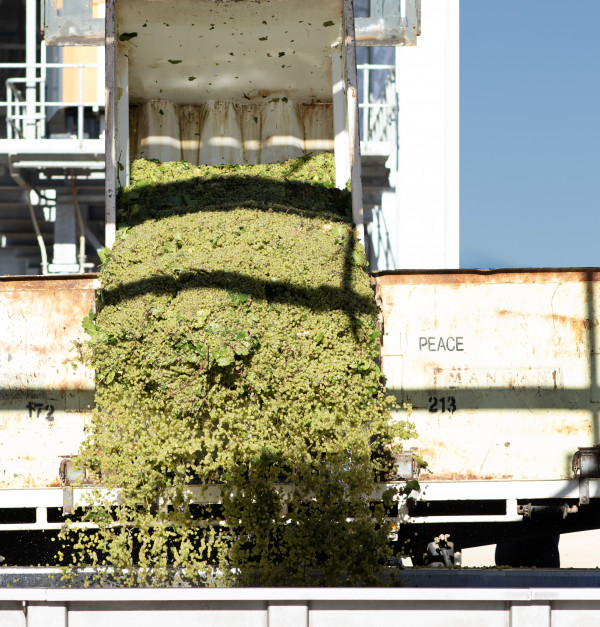
THE Australian winegrape crush increased year-on-year by 9 per cent in 2024 to an estimated 1.43 million tonnes, according to the National Vintage Report 2024 released this week by Wine Australia.
Vintage 2024 follows a 23-year-low crush in 2023 and, despite the growth, this year’s crush is still well below the 10-year average of 1.73 million tonnes.
Wine Australia market insights manager Peter Bailey said there had been a declining trend in the Australian winegrape crush over the past few years.
“This is the third vintage in the past five that has been below the 10-year average,” Mr Bailey said.
“As a result we’ve seen the five-year average decrease by over 100,000 tonnes in the past two years.
“However, the reduction in the crush doesn’t necessarily reflect a decrease in the underlying supply base.
“There is no indication that the vineyard area has declined significantly so the potential for a large crop still exists without active management of yields.”
The overall year-on-year increase in the crush was 112,000 tonnes, driven entirely by white winegrape varieties, which increased by 117,000 tonnes (19 per cent) to 722,000 tonnes.
Despite the 19 per cent increase, the white varieties crush was still 10 per cent below the 10-year average and the second-smallest in 17 years.
The crush of red grapes declined by just under 5000 tonnes (1 per cent) to 705,000 tonnes – the smallest since the drought-affected 2007 vintage and 40 per cent below its peak of 1.2 million tonnes in 2021.
The white winegrape share of the crush increased to 51 per cent – the first time since 2014 that the white crush had been higher than its red equivalent.
“The overall reduction in the red crush is entirely driven by Shiraz, which decreased by nearly 48,000 tonnes while most other red varieties increased,” Mr Bailey said.
“This decrease was not just from the inland regions, with the Barossa and Clare valleys accounting for one-third of the reduction.
“Seasonal factors have contributed to 2024 being another small vintage.
“However, the significant further reduction in the red crush can be largely attributed to decisions made by grapegrowers and wine businesses to reduce production.
“These decisions are being driven by low grape prices, significant red wine stock overhangs and reduced global demand for wine.”
Chardonnay increased by 31 per cent to 333,000 tonnes, overtaking Shiraz to resume the title of largest variety by crush size that it last held in 2013.
Shiraz decreased by 14 per cent to 298,000 tonnes – its smallest crush since 2007.
CRUSH BY REGIONS
LOOKING at the crush over time, the three largest states have shown a decreasing trend, with the five-year average lower than the 10-year average, and the 2024 crush lower than both.
Conversely, the three smallest states have shown a general trend of increasing volume, although this could be partially attributable to an improvement in response rates over time.
The three large inland regions – Riverina (NSW), Murray Darling-Swan Hill (NSW and Victoria) and the Riverland (SA) – together accounted for 72 per cent of the national crush, returning to their 10-year average share after dropping to 68 per cent in 2023.
The crush itself for these inland regions combined is estimated to be 1.03 million tonnes – 18 per cent below the 10-year average of 1.25 million tonnes but 14 per cent higher than the previous year’s crush of just 898,242 tonnes.
Conversely, the rest of Australia saw a decrease in estimated tonnes from 416,376 tonnes to 401,307 tonnes (down 4 per cent) – the second-smallest crush in the past 10 years (the smallest was 332,029 tonnes in 2020) and 17 per cent below the 10-year average.
The growth in the inland regions was driven by substantial increases in the crush from Murray Darling-Swan Hill and the Riverina (both of which experienced extremely low vintages in 2023), partly offset by a small decrease in the crush from the Riverland.
Murray Darling-Swan Hill increased by 38 per cent, from 205,061 tonnes to 282,338 tonnes, while the Riverina increased by 15 per cent from 200,117 tonnes to 230,985 tonnes.
Despite the increases, both regions were at least 15 per cent below their 10-year averages.
After recording the lowest crush for 10 years with 410,888 tonnes in 2023, the Riverland saw a further 5 per cent decrease to 391,248 tonnes in 2024 – very similar to the 2013 crush of 396,199 tonnes.
Over the past five years (up to 2023), the average crush for the Riverland has been 482,277 tonnes, making this year’s crush 19 per cent below the average.
NSW and Victoria had the second- and third-highest crushes respectively behind South Australia.
NSW had an estimated 417,965 tonnes – up 18 per cent compared the previous year but still 21 per cent below its 10-year average.
It accounted for 29 per cent of the national crush compared with 27 per cent in 2023.
The estimated crush from Victorian vineyards was 248,105 tonnes – up 43 per cent year-on-year but still 13 per cent below its 10-year average.