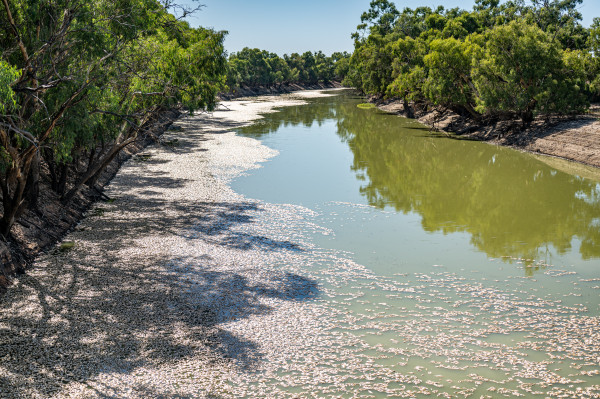
SWAN Hill Council has called for improved seasonal river flow to help prevent future fish deaths.
The council unanimously supported a notice of motion from Cr Nicole McKay at the September ordinary meeting, which included writing to federal Water Minister Tanya Plibersek, Victorian Water Minister Harriet Shing and NSW counterpart Rose Jackson.
Cr McKay told the council in her preamble the goal of the Murray-Darling Basin Plan was to ensure adequate flows in the river systems of the Murray-Darling to maintain water quality to support people and ecology, the supply of water to river communities in all regions, while enabling horticulture industries to flourish.
“Before the mid-1990s, the Murray River regularly flowed between 20,000 to 25,000 megalitres per day at Swan Hill during the seasonably appropriate period between late winter and early summer,” she said.
“This flow enabled regular flushing of the system … in the Mid-Murray region, promoting fish breeding, and maintaining water quality by reducing organic matter on the floodplain.
“During negotiations around the basin plan and water management, flows have been restricted to around 17,000 ML/day at Torrumbarry, for managed releases, in particular releases of environmental water.
“This has meant the regular flushing of the system has not occurred, contributing to cyanobacteria – when flows are low – and blackwater, when uncontrolled major
flooding sweeps vast quantities of organic matter into the river system.
“System wide, blackwater is a new phenomenon in the Mid-Murray, occurring first in 2011, with follow up events in 2016 and 2022-23.
“Both blue-green algae and blackwater cause mass fish, yabby and crayfish deaths.
“Poor water quality also badly impacts on recreational users and tourism.”
Cr McKay said enabling “moderately higher flows”, the river system would mimic natural flow regimes at minor flood levels.
“The Constraints Measures Program Feasibility Study recognises that some achievable first steps to begin the process of constraints relaxation are to moderately increase flow levels to a level that does not impact private land, but which will contribute to improved ecological and water quality outcomes,” she said.
“Careful utilisation of tributaries can mitigate risk to private land, as was achieved in the managed environmental flow of 2021.”
During debate, Cr McKay said when she was “young until the mid-90s”, there was a seasonal high river in winter and spring most years and never had there been a “systemic” blackwater event – only small and isolated events.
“Since about the mid-90s, there have been two major blackwater events on the Murray and another on the Wakool system,” she said.
“In the studies I have referred to, the cause has been we have not had the seasonally high rivers to flush the system out.
“So when there is a very large flood every six to 10 years, we have had huge amounts of organic matter spill into the river.
“The other part of the higher rivers – and not talking about major floods – just those that reach into the creeks, billabongs and lakes of our region, is that downstream of Swan Hill, lakes, creeks will get water on regular basis.”
Cr McKay said when friends had visited during past floods, they described the environment as “Kakadu without the crocodiles”.
“This could be a high attraction if we bring life back to the floodplain downstream of Swan Hill,” she said.
“It’s very, very hot in summer and it’s really not a lifestyle but a way of life of fishing, camping and skiing.
“Having access to recreational and environmental water in our region will improve out natural environment, but also prevent those toxic fish issues that have been so distressing.
“I grew up fishing. I know how to put a worm on a hook, and nothing is more upsetting than to see fish die.”
Cr Bill Moar said the municipality wanted outcomes after all the “pain” rural communities had gone through in the water buyback process.
“To date there has been very little in terms of outcomes and one could argue we are worse off,” he said.
“There have been three major fish kills since buybacks began.
“In the history of time, from the 1950s to 1990s, it was an overly wet period after the Federation drought. Rain increased by 25 to 30 per cent then turned dry again in 1993.
“We’ve been in that dry period until now and slowly recovering.
“We had at least a 50-year dry period and 50-year wet period, that said we bought water back and those outcomes will apply, we want those outcomes to apply and be tangible over the ensuring time – wet or dry.”
“I’m certainly suggesting the constraints are part of that.”
Cr Moar said the management of the system “has to change”.
“It has to change to get these outcomes, that is to mimic nature,” he said.
“When it rains, let the water go, don’t leave it in the dams, let it go as nature intended.
“We can’t ever hope to get back to nature because there are just too many constraints – every road, every bridge in the floodplain.
“The system that has lots of constraints, but we must get it close to nature, how nature provided rainfall in the first place.”
The council moved to express support for the Constraints Relaxation Program in both the Victorian and NSW river systems and encourage the program rollout be expedited for the benefit of downstream communities, and to express support for moderately increasing flow levels above current practice, to maintain water quality, and support the environment of the Mid-Murray, where there will not be an impact on private land.