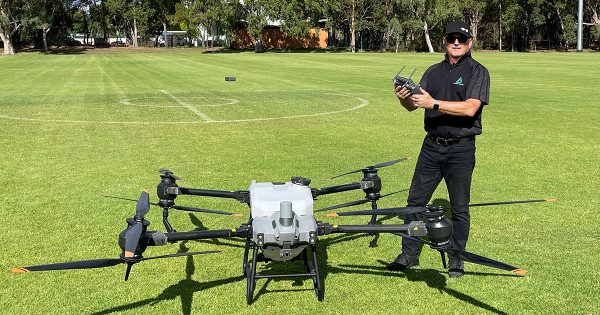
AGRICULTURAL drones designed and built specifically to apply crop inputs are now an affordable option for individual farming businesses.
Australia Agritech project manager Gary Rentenaar has recently seen demand for drone technology surge in situations where very wet conditions during the cropping season make ground spraying impossible.
He said in areas where wet conditions spiked a high demand for aerial applications, they also caused long delays in booking planes and helicopters.
So many growers turned to drones to get their spraying done in a timely manner.
Raising the question: Will drones become a routine spraying option on farms or remain as a wet weather back-up option?
Gary has provided North West Farmer some key pointers for growers interested in investigating the potential of using drone technology for weed detection, mapping, and spraying (this summary relates mainly to DJI agricultural drones, which are used in more than 50 countries).
Drones have the potential to assist graingrowers with several aspects of the WeedSmart Big 6 strategy, including targeted and effective herbicide application in wet seasons.
DJI and XAG are the leading spray-drone manufacturers supplying the Australian market and drone uses for broadacre weed management include:
• In-crop herbicide application: blanket application now, green-on-green drone spot-spraying is likely in the future
• Weed mapping: green-on-brown is easy, green-on-green weed detection is improving
• Summer spot-spraying: using a ground spray rig working off a green-on-brown drone weed map, green-on-brown drone spot-spraying in the future
• Identifying areas of poor germination or misses at seeding
• Keeping data and map records on your phone or desktop for comparisons
Other uses around the farm include prescription mapping for on-ground variable rate applications, applying fungicide and insecticide, spreading mouse and snail baits and beneficial insects, and monitoring crop growth.
Chemical companies have not typically developed products with drone application in mind. Chemicals registered for aerial application may be applied using drones, following the same application requirements on the label.
Users must comply with the spray quality instructions on the product labels for aerial spraying. Droplet size can be adjusted between 50 and 500 micron. The flow rate can also be adjusted. Wind affects spray patterns and can restrict the area sprayed in a day.
Initial observations and testing with water-sensitive paper indicate the downdraft of the blades and the low flying height can assist with the coverage of the target and reduce spray drift. Ongoing research and development will refine the best practice for drone spraying.
The tank capacity and payload vary for each drone model. For example, the DJI Agras T50 has a 40L spraying payload and can spray at a rate of 16L/min. With extra nozzles, the spray rate can increase to 24L/min. When spreading, this drone has a 50kg payload and can spread a full load in about 30 seconds.
DJI Agras T50 drones can typically fly for up to 10 minutes and usually empty the tank before needing a battery replacement.
It’s essential to manage the tank capacity to avoid running out of battery before emptying the tank. One way to increase flight efficiency is to keep the flight path back to the refill station as short as possible.
Typically, the drone returns for refilling with 40 to 50 per cent battery charge remaining, reducing the recharging time. Having three batteries to rotate and a fast-charging station keeps the drone spraying with minimal downtime.
Drones typically cover 125 to 200ha a day, depending on various factors like spray type, weather, and flight speed. They can cover 1.5 to 2ha per tank, typically applying about 20 to 30L of spray per ha when using a drone to apply herbicide. Minimal set-up and preparation time are needed before starting a spray job.
Drones are particularly well suited to farms with smaller paddocks and farms located close to towns, where planes and helicopters are less suitable.
Agricultural drones need obstacle detection, obstacle bypass (accurate mapping is required, especially of powerlines), terrain-follow and reliable connectivity features. The capability to rapidly refill the tank and recharge the batteries is also necessary for maximum efficiency.
When spraying, the drones typically fly three to five metres above the target (crop or ground) using their terrain-follow capability. A forward speed of 30km/hr provides safe and effective spraying.
Drones must be operated within the regulations set out by the Civil Aviation Safety Authority. To fly a drone weighing more than 25kg on your own land, the pilot must obtain a remote pilot license (RePL) and type endorsement.
This applies to drones such as the Agras T50, which has a maximum take-off weight of 103kg and an empty weight of 50kg.
RePL training is a five-day course (three days of theory and two days practical). The type endorsement is an additional one-day training. The training is essential for obtaining suitable insurance.
To operate as a drone service provider (contractor), you will need a remotely piloted aircraft operator’s certificate.
A drone pilot may only operate one drone at a time, and the drone must remain within line of sight. However, some contractors may have multiple pilots, each operating a drone on the same spray job.
Ensure you keep up to date with any changes to the CASA rules.