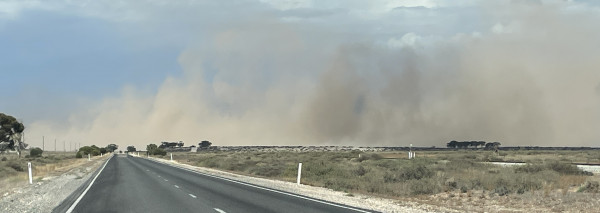
DUST storms across the Mallee earlier this week are a reminder of how fragile some of our soils are.
On Monday, people driving between Ouyen and Piangil were forced top pull off the road when a heavy dust storm reduced visibility to almost zero.
Helen Dalwood, headed for Swan Hill, said when she first saw the dust cloud way ahead of her she thought nothing of it, but with the wind blowing it her way on the Mallee Highway she suddenly realised how big the bank of dust was – and how thick.
“It was amazing, it just kept coming, and kept climbing into the sky,” Ms Dalwood said.
“At first I thought it would be fine as you could still see, then suddenly the bulk of it arrived and the road and surrounding countryside just vanished.
“I had to pull over, I couldn’t see anything and I was really worried anyone who kept going could drift off the road and hit me.
“Fortunately it cleared after a couple of minutes and although we hit a couple more, that was the only bad one we hit.”
Agriculture Victoria land management extension officer Clem Sturfels said the dust storms are also a good reminder there is still time to prevent this damage by de-stocking more vulnerable areas of the farm.
Mr Sturfels said while dust storms contain mostly mineral materials, they also contain significant quantities of organic matter, one of the most valuable components of our soils.
He said leaving stock in a paddock for an extra couple of weeks to make use of remaining water supplies can be all it takes to expose the paddock to the risk of wind erosion.
“Dust storms or wind erosion occur when the speed of the wind at the soil surface exceeds the forces holding soil particles in place,” he said.
“Typically, soil particles exist as a small pea sized peds or aggregates.
“As these peds or aggregates break down the soil becomes more vulnerable to erosion.
“Once the process of wind erosion starts it can be nearly impossible to stop as the larger sand grains bounce and roll across the soil surface, stripping remaining vegetation and smashing (or sand blasting) the soil in front of them.
“The most vulnerable areas are those with lightly textured soils, little groundcover and shelter belts and topography that exposes them to high wind speeds.
“Lighter textured soils are those containing a high proportion of sand with little or no clay.”
Mr Sturfels said wind erosion can start anywhere the soil has been disturbed, such as in gateways, along tracks and around water troughs.
He said the key to preventing wind erosion is to maintain as much ground cover as possible and avoid disturbing the soil.
Which means aiming for 80 per cent cover in pasture paddocks and 60 per cent cover in crop stubbles. Ground cover also helps moderate temperature extremes in soil and retains moisture.
“Maintaining good ground cover will reduce the risk of wind erosion but will also reduce damage to pastures and assist with a faster recovery following the autumn break,” he said.
“Bare soil is also more susceptible to oxidation and microbial activity which can release stored carbon as CO2.
“Building the soil carbon levels back up can take years in drier climates. Soil carbon is a valuable soil resource as it improves soil structure, increases water retention and nutrient availability.
“When groundcover levels are low the only practical way to reduce the risk of wind erosion is to remove livestock to other paddocks or place stock in a stock containment area.”