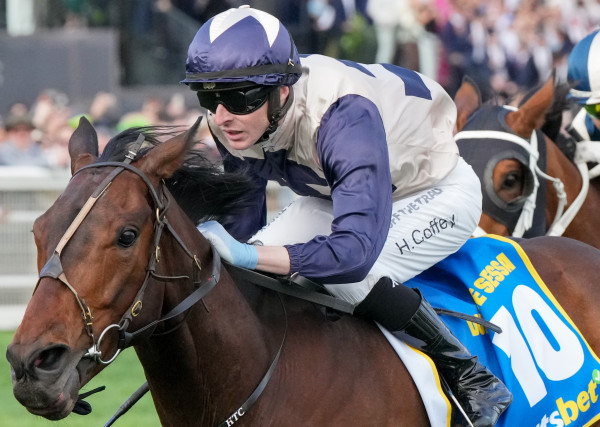
IF Harry Coffey came back to racing reality with a thud on Sunday, going around at an Echuca bush meeting for $27,000 purses, I doubt he either heard or felt it.
Harry was on such a high after winning Saturday’s $5 million Group 1 Caulfield Cup with Duke De Sessa it’s unlikely he’ll be feeling anything for some time to come, except the vibes of that seriously storybook moment, rising in his irons and fist pumping the air as he crossed the line.
If he seemed a little dazed that was also understandable – as best he could recall, he had not had a minute’s sleep since becoming the toast of the racing world.
His voice was raspy and failing fast from the interviews, the excitement and the celebrations, and from wasting 2kg, or almost 4 per cent of his bodyweight, to make the ride.
None of which stopped him for reporting for his six rides, 236km up the Northern Highway, on Sunday.
Yet this was a moment Coffey should never have had.
Born with cystic fibrosis and all its attendant, even life-threatening challenges, the furthest thing from anyone’s mind would be hauling your slight, oxygen-depleted frame aboard half a tonne of highly strung thoroughbred and hanging on while it raced around a track.
To which Coffey added, “but if I didn’t have CF, I doubt I would have ever become a jockey, it has kept me nice and light.”
As his trainer father Austy pointed out between races at Echuca, racing is “a great leveller”.
Friday night, even though he didn’t really want to be there, Coffey went to Cranbourne, got a second, a handful of unplaced runs – and a suspension.
Saturday afternoon, and he really wanted to be there, he was at Caulfield and riding into racing folklore.
Sunday he turned up at Echuca for no success, but riding a few for Dad, so happy to be on hand there as well.
Yesterday he was at Horsham for trials, and he was booked for that so had to be there, too.
He might have been given an eight-meeting suspension but that doesn’t stop the early mornings, the travel, and the rides.
In racing parlance, the stewards have given him a holiday, but it’s not what you and I would expect, even from an enforced layoff.
Harry was suffering from serious interview hangover by Sunday, and every time he emerged from the jockeys’ room he had phones shoved in his face for photos or was being stopped by people for selfies.
Also all understandable.
Very few jockeys, trainers, owners or horses share in the story of the Victorian racing’s Holy Trinity – the Melbourne Cup, the Cox Plate and the Caulfield Cup.
Those who do it more than once are much rarer.
Harry Coffey now has his foot in the door of that most exclusive of clubs and is on his way.
A season ago he had just one Group 1 win beside his name, the 2018 Australasian Oaks in Adelaide.
Now he has three, this year’s Oakleigh Plate and now the Caulfield Cup.
But if Coffey on Sunday was exhausted, Coffey senior was still elated.
He doesn’t admit to shedding a tear as he and wife Maree watched their son win the biggest race of his career, but he conceded “I have had a bit of trouble with hay fever”.
The connection between father and son is tangible.
One of the things Harry insisted telling post-race interviewer Charlotte Littlefield as he rode back to the mounting yard was his dad had wanted to come with him to Caulfield, but he had told him “not to worry about it, I’ll handle it without him”.
“He actually nearly caught the train down this morning and was going to drive me home tonight and I said to him ‘nah, I might have a beer tonight.’
“So sorry Dad, that I told you not to come.”
Austy said he and Maree watched the race from their lounge room, and while he was not sure how Harry’s horse would go, he felt a lot more confident when he saw the big bucks coming for it, pushing the price from $41 to $11.
He said he had not seen his son win his first Group 1 in Adelaide; he had been asked not to go.
“We had talked about me going down to drive him, but the plan had been for me to stay here and get the horses ready for Echuca, and Harry wanted to go the night before and he was still working on losing that weight,” Austy said.
“But he’s worked so hard to get here, harder than most have to, and has earned this moment.”
Harry’s story is already racing legend, diagnosed with CF at six weeks, whose parents were told they might not have him long, who racing stewards said would never be allowed to ride because of his incurable and debilitating disease, and who proved them all wrong.
“He kept hounding the stewards, ringing all the time and I just said to them: ‘Let him ride at Manangatang and Balranald and Wycheproof, and we will go from there’,” Austy said.
Finally, the father got the green light to take his son on as an apprentice.
If you turn the clock back to Caulfield Cup day eight years ago, Coffey and son were racing at Wycheproof, where they would win five of the seven races – and Harry bagged a sixth for a different trainer.
Father and son were right, and everyone else was wrong.
So very wrong.
After all those incredibly hard yards, the turning point arrived three years ago – and it was called Trikafta.
“For the past few years, I’ve been on this new drug, and it has done wonders – I have more energy,” Harry said.
“The drug tricks my body into thinking it has a gene that I’m actually missing, and the result is I don’t get as short of breath, I have better lung capacity, and I remove mucus from my lungs more easily.
“I’m also less prone to infections now. I’ve halved my regular dose of medication.”
Dad calls it “life changing”.
And then beaming, he nailed it about his son in a few simple words: “He has turned into a champion.”
A champion true to his roots.
With the career he had, even before Saturday, Harry could be, would be, expected to have relocated to Melbourne, or one of the big training hubs such as Ballarat or Bendigo. Even Hong Kong.
But he still lives in Swan Hill, prepared to travel all those extra kilometres to be with wife Tayla and their son Thomas, on their farm and close to family and friends.
Saturday was Harry’s 29th birthday – that’s one hell of a present, a Group 1, a Caulfield Cup, and a slice of $3 million in prizemoney.
But whether it’s Melbourne or Manangatang, father and son still have that unshakeable bond, cemented in the frightening days of his childhood, and polished as master and apprentice.
Austy confides after every race day they still share a phone call, and a laugh, as they go through his rides, talk about the good stuff, the lucky stuff and the things he shouldn’t do again.
The other thing about Harry is he is the darling of the post-race interview circuit.
Entertaining, insightful and never short of a word, he always gets a much longer run than most of his peers.
Yet straight after he won on Saturday, even he seemed so overwhelmed by the moment he was genuinely struggling to articulate the ecstasy.
Although once he got the first few words out, he was very quickly good old Harry again, that cheeky big grin, a dash of homespun humour, and a winner.
But when you think about it, Harry has been a winner since he was about six weeks old.