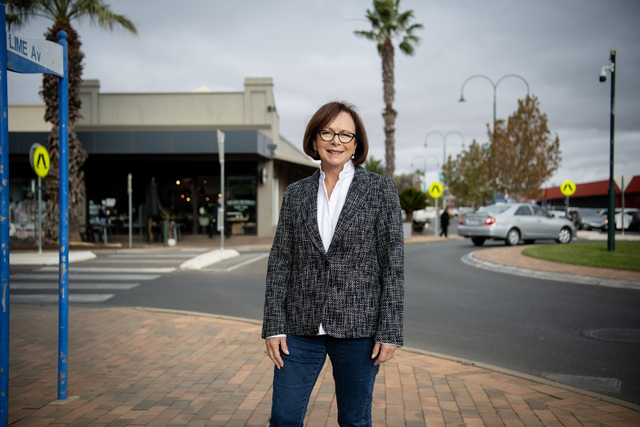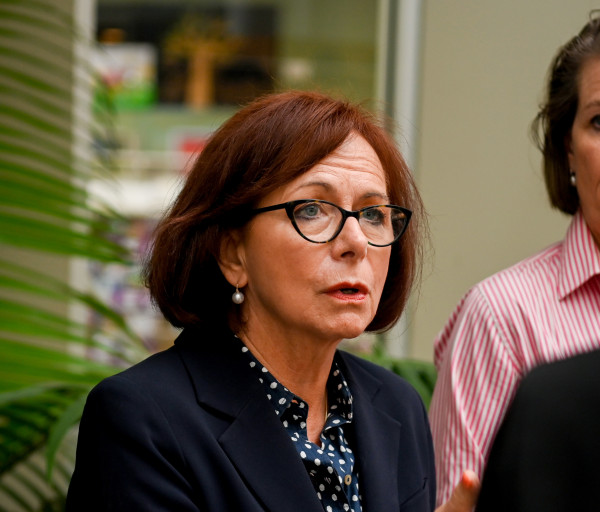
MEMBER for Mallee Anne Webster says the VNI West power interconnector project will not need to proceed after the Federal Coalition announced it would develop a policy for nuclear power in Australia’s mainland states.
The Coalition has said it would cap the renewable energy rollout if it regained power at the next federal election.
Federal Opposition Leader Peter Dutton last week announced his plan, with seven sites earmarked for a 30-month community consultation.
Dr Webster said she had advocated a “mature conversation around nuclear energy” since she was elected in 2019.
“It should be part of our baseload power mix for the sake of industry, for the sake of manufacturing – if we really want Made in Australia to happen we need reliable affordable power,” she said.
Dr Webster said she was pleased that Australia was talking about real policy that would make a real difference.
The Coalition has not yet released costings or a timeline for the plan, promising more detail soon.
Dr Webster has criticised the Victoria to New South Wales Interconnector (VNI) West proposal for the lack of social licence to construct new power lines in Mallee, saying people were “not happy about” the potential for compulsory acquisition of the land.
“The point of nuclear is that none of (VNI) is going to be necessary, and that is a huge relief across Mallee that these transmission lines will not have to go ahead, because if Loy Yang is set up as a nuclear power site, then the existing transmission lines – albeit some of them will be upgraded – will already deal with the transference of electricity from the nuclear site to where it is required, including across borders.”
The VNI West project is designed to transmit renewable energy between Victoria and NSW.
Transmission Company Victoria said in a statement: “As old coal-fired power stations close, VNI West will play a vital role in keeping the lights on across Victoria.
“VNI West will allow more renewable energy into our grid, including hydroelectricity from the Snowy Mountains Scheme,” TCV said.
The Coalition’s press release criticised the Federal Government for its 65 to 70 per cent emissions reduction target by 2035 without modelling or power-price increase projections.
The government’s targets are to meet the legally binding Paris Agreement to peak fossil fuel emissions by 2025 and reduce global emissions by 40 per cent by 2035, which was initially agreed on by Tony Abbott’s Coalition government in 2015.
The Coalition’s announcement did not include site assessments or approvals, uranium sourcing and processing plans, or explain how a Coalition government would overcome legal barriers to nuclear power in Australia, Victoria, New South Wales and Queensland.
Nuclear power has been banned at federal level since 1998 under the Australian Protection and Nuclear Safety Act 1998 and the Environment Protection and Biodiversity Conservation Act 1999, which “expressly prohibit the approval, licensing, construction, or operation of a nuclear fuel fabrication plant; a nuclear power plant; an enrichment plant; or a reprocessing facility”.
A Coalition government would need to overturn this legislation before any development could begin, which would require a Lower House election victory and support in the Senate.
It appears that neither the crossbench nor Labor senators would vote for such a move.
Alinta Energy chief executive Jeff Dimery told the National Press Club in April that overturning any such ban would be a “lengthy process” and the extended timeframe and market uncertainty was a prohibitive factor for private or commercial investment.
“The legislation isn’t conducive to us even exploring (having nuclear in the market by 2035 or 2038),” Mr Dimery said.
Alinta Energy is one of Australia’s largest electricity companies by market share.
The Coalition has not ruled out compulsory acquisition of the proposed nuclear sites, and federal Nationals leader David Littleproud told ABC’s Afternoon Briefing this would be a “last resort” if communities and landholders did not support building nuclear reactors.
Mr Littleproud also admitted that the proposed sites had had only had preliminary assessments and further work would be needed.
The earliest nuclear power could feasibly come online is 2035, and all seven sites could produce a total of only 6.4GW, which is less than a third of the 22.3GW of coal currently in operation, according to ABC reporting.
The Australian Energy Market Operator has predicted that Australia’s energy requirement would double by 2050.
Smart Energy Council analysis suggests that the seven proposed nuclear reactors could produce only 3.7 per cent of Australia’s energy mix by 2050.
With an expected closure of all of Australia’s coal-fired power stations by 2038 and the Coalition simultaneously committing to a cap on renewable energy investment, a supply of gas would be required to support the national energy grid.
Green Energy Markets director Tristan Edis told The Guardian Australia that an increase in gas power to replace coal and supplement the energy grid could result in a $500 to $1000 increase in annual household power bills.
University of New South Wales renewable energy and energy systems analyst Dylan McConnell’s analysed AEMO’s 2024 Integrated System Plan, saying that the gas required to firm a renewable energy grid would still be less than current levels used to supplement coal-fired power.
“If we can banish almost all fossil-fuel generation from our main grid by 2034, we will be doing well,” Mr McConnell said.
“Even if this were all fossil gas – which it won’t be – the emissions intensity of Australia’s main grid would be miniscule – around 0.01 tonnes per MWh, or 60 times lower than today.”