THE Swan Hill municipality may experience both a shortage of industrial land and a limited number and diversity of vacant lots within Swan Hill in the next decade.
That’s according to an industrial futures discussion paper, released by the council last week.
As part of the initial consultation phase, the council has invited feedback from residents, businesses, and stakeholders on the paper, which outlines potential sites for rezoning to support industrial development.
Director of development and planning Michelle Grainger said the strategy is a vital step in shaping the region’s economic future.
“We’re committed to ensuring Swan Hill has a well-planned supply of industrial land that meets the needs of enterprise, industry, and our community,” Ms Grainger said.
“This strategy will provide clarity and direction for industrial land use and development, while also ensuring new projects contribute positively to the amenity and environment of Swan Hill.”
Four sites have been identified for potential rezoning to an industrial zone.
Swan Hill’s industrial zoned land comprises 160 hectares of zoned industrial land which is spread across two distinct precincts: the Karinie Street and Quin Drive industrial estates.
The paper said these precincts support a diversity of businesses including major waster, agricultural supply, automotive, manufacturing, energy and chemical and logistics enterprises.
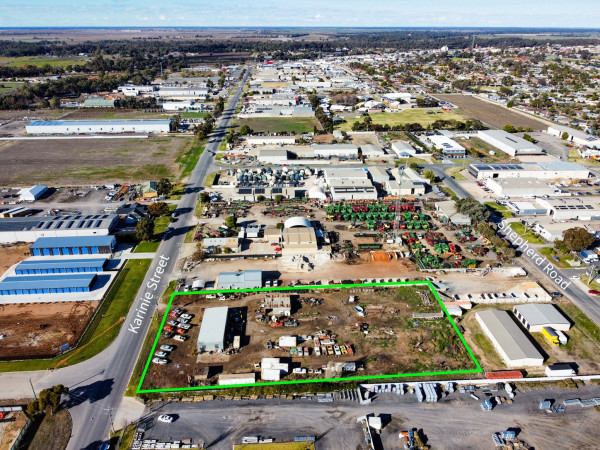
Karinie Street is Swan Hill’s major industrial area expansion area supporting industrial growth and development.
The precinct currently incorporates a total of 69.8 hectares of available land supply. This includes land identified as vacant and land currently used for non-industrial purposes.
Since 2007, about 24.6 hectares of land was developed for industrial uses across five key sites. This is indicative of an annual average development rate of 1.5 hectares between 2007 and 2024.
“Over this time, the precinct experienced periods of significant development including the development of eight hectares of land between 2021 and 2022. There were also periods of minimal change,” the paper noted.
“Mooted and approved proposals since 2022 suggest that the precinct is on the verge of a new wave of industrial development and growth.
“Assuming that current permits are acted on, there is the potential that the municipality may experience both a shortage of industrial land and a limited number and diversity of vacant lots within Swan Hill within the medium-term (10 to 15 years).
“Karinie Street is the municipality’s leading and most active industrial area. As such, a constraint on available industrial land will limit investment, job growth and output in the community which is a community that is highly dependent on production for its income.”
Area No. 1 of potential industrial expansion investigation area is to the west of Karinie Street, and spans 107 hectares across two lots.
A1 is subject to drainage issues which may constrain its development potential.
Investigation area No. 2 encompasses 20 hectares on a singular lot.
A2 is subject to cultural heritage sensitivity which may constrain its development potential; however, the locations of sensitivity are within specific areas.
The paper said, otherwise, these areas “maintain minimal environmental and regulatory constraints”, making them potential candidates for industrial expansion.
Area No. 3 to the west of Quin Drive encompasses about 25 hectares on a singular lot. The area directly abuts the Swan Hill landfill.
Its proximity to residential areas may limit its potential for industrial development in light of recent amendments to the Separation Distance Guideline by the EPA.
Council is seeking community input on these locations – or suggestions for other suitable sites – to ensure adequate supply for future growth.
To have your say, visit letstalk.swanhill.vic.gov.au and complete the short survey.