A quiet crisis is unfolding inside large enterprises. It is different from the one dominating headlines. Mass redundancies, the urgency to reskill, and debates over which tasks AI can perform faster than humans are only the visible symptoms. The underlying issue runs deeper: work itself is changing.
Beyond the tools and the pace, the very architecture of work, how tasks, roles, and responsibilities are structured, is being dismantled and rebuilt. Yet most organisations continue to operate as though that architecture remains intact. This is a work design problem rather than a technology one, and it may prove to be one of the defining organisational failures of this decade.We are not facing a workforce crisis. We are facing a work design crisis
For decades, work was treated as stable. Organisations defined roles, mapped them to skills, and embedded them into workforce plans. Technology evolved in waves, processes improved, and efficiencies were extracted, but the structure of work itself remained largely unchanged. That assumption no longer holds. The shift is happening quietly but decisively, and organisations that fail to recognise it risk optimising a system that no longer exists.
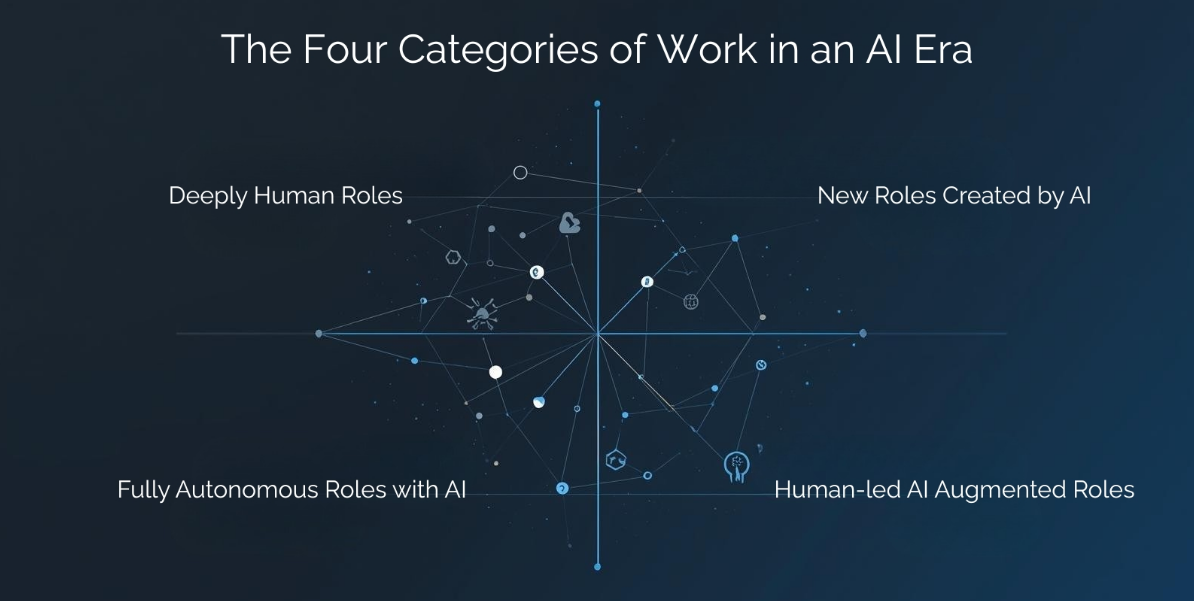
The four kinds of work in an AI era
Artificial intelligence is beyond simply automating tasks at the margins of work, it is reshaping the composition of work itself. What is emerging across industries is a rebalancing across distinct types of work.
Some work can now be executed autonomously by AI with minimal human involvement. Some remain human-led but are fundamentally transformed by AI augmentation, changing the nature of execution. Entirely new categories of work are being created as AI expands what organisations can do, while a segment of work remains deeply human, requiring judgment, context, and creativity that cannot be easily replicated
What makes this shift difficult for organisations to respond to is that these categories are not fixed. The proportion of work within each is continuously evolving, often faster than traditional planning cycles can accommodate. Yet most organisations continue to operate as if these proportions are stable. They forecast headcount based on outdated role structures, hire against job descriptions that no longer reflect reality, and invest in skills without redesigning how those skills will be deployed.
The result is a growing disconnect between the workforce organisations build and the work they actually need to execute. Companies are investing in AI while leaving the underlying architecture of work unchanged.Companies are investing in AI while keeping the old architecture of work entirely intact.
The costly illusion of transformation
The consequences of this disconnect are already visible, even if they are rarely diagnosed correctly. Consider a technology services firm that invests heavily in AI over several years. It hires data scientists, upskills its engineering workforce, and deploys automation platforms. On the surface, the organisation appears to be transforming. Yet the expected productivity gains fail to materialise at scale.
The issue is that the work has not been redesigned around technology. Engineers continue performing tasks that AI could handle, not because it is the optimal choice but because the structure of the role has not been questioned. AI tools remain underutilised because the operating model was never reconfigured to integrate them effectively. The organisation has added new capability to an old system and assumed that transformation would follow.
A similar pattern plays out in customer operations. Organisations deploy chatbots, automated triage, and intelligent routing, but retain role structures and escalation frameworks designed for a pre-AI environment. The result is fragmentation. Work flows break across systems designed for different realities, customers experience inconsistency, and employees navigate unnecessary complexity. The efficiency gains promised in business cases fail to materialise in practice. The failure here is the absence of a more fundamental question: what should work actually look like when AI is embedded into how the organisation operates?
Redesigning work as a continuous capability
A small but growing group of organisations is beginning to approach this question differently. Instead of treating workforce planning as a static exercise, they are starting to view work itself as a dynamic system that must be continuously examined and redesigned. This shift, while conceptual at first glance, has deeply practical implications.
When roles are treated as fluid rather than fixed, organisations can redeploy talent more effectively in response to changing demand. When AI is embedded into the design of work rather than layered onto it, adoption becomes more natural and impactful.
When work is continuously redesigned, organisations can adapt without relying on disruptive, large-scale restructuring cycles. What emerges is not just agility in the traditional sense, but structural adaptability, the ability to reconfigure work at the pace at which the environment is changing.
Enabling this shift requires more than incremental process improvements or cultural change. It requires a different class of systems. Traditional HR platforms were designed to manage people, transactions, and records. They were not built to interpret how work itself should evolve. As a result, intelligence remains fragmented across disconnected tools, skills frameworks, workforce demand signals, learning systems, and staffing platforms that do not align.
Some organisations are beginning to address this gap. Spire.AI, for example, has developed context intelligence platforms such as evoSapien, designed to continuously re-architect work through integrated workforce planning, realignment, and execution. These systems convert fragmented enterprise signals into decision-ready intelligence, enabling organisations to redesign work, align workforce capability, and integrate AI into execution in a coordinated and ongoing way. It changes how organisations respond to change itself. Redesigning work is not a one-time initiative. It is becoming a continuous operating capability.
The compounding cost of standing still
Organisations that take this shift seriously will build an advantage that compounds over time. By continuously redesigning work, they avoid the repeated disruption of large transformation programmes. They can redeploy talent faster as demand shifts, and they can integrate new technologies into execution without the friction that comes from trying to fit them into outdated structures.
Those that do not will face a familiar but increasingly costly pattern. Periodic transformations to catch up with changes that have already taken place elsewhere. Rising workforce inefficiencies as the gap between roles and actual work continues to widen. AI investments that fail to deliver their full potential because the system into which it is introduced has not evolved.
The distinction begins subtly, the difference between treating work as fixed and treating it as something that must be actively engineered. Over time, however, that distinction becomes strategic. Much of the current debate has focused on which jobs AI will eliminate. While that question is valid, it risks distracting from a more urgent one: how should work be designed in a world where AI is a permanent part of the operating model?
Organisations that answer this question will find themselves better positioned to navigate change. Those that avoid it will continue reacting to shifts they never structurally prepared for. The question is no longer whether work will change. It is whether organisations are designed to change with it.