SWAN Hill’s Jenny and Tony Waldron have closed off a volunteering career spanning 40 years with a seven-month stint in Kiribati, a small island nation in the middle of the Pacific.
In January this year, Jenny and Tony packed their bags, boarded a plane and headed off to join the staff at the Kiribati School and Centre for Children with Special Needs (KSCCSN).
The school provides services to children with disabilities and currently educates over 230 children.
Established in 1991, it is the only one on the island which caters to children with special needs, with both sign language and braille taught.
It is also working to change attitudes and ensure child protection as the society works to overcome the stigma attached to disability.
They returned home in August this year, bringing with them stories of life on Kiribati, 30 kilometres long and just 30 metres wide in some places, with a population of 110,000 spread over two islands.
Tony and Jenny joined the school through the Australian Volunteers Program, part of the federal government’s aid program, and had nothing but praise for the staff and their time on the island.
Tony volunteered as a mentor to the school principal, while Jenny worked to adapt the Kiribati curriculum for deaf students and improve the English skills of staff.
It was far from their first time as volunteers, having met while volunteering in Papua New Guinea 40 years ago, where they stayed for quite some time.
They later spent four years working with Watoto orphans in Uganda from 2005 to 2009.
This time around, Tony said they were looking to once again share their skills, but for a shorter term.
“We still get emails as return volunteers and this time last year we just sort of said ‘Oh, we really don’t have anything planned for 2019’, which was unusual for us, we’re usually booked up,” Tony said.
“And then I read this email, they wanted a mentor for a principal of a special school for seven months in Kiribati.
“I had been principal in Papua New Guinea and Uganda, and I had worked at the special school here (Swan Hill), so it was the ideal opportunity for me, and a way of finishing my career, volunteering and using my experience to give back.”
A look at Jenny’s CV and the Waldrons were told the school could “certainly” find a position for her too.
“I worked with the teacher of the deaf, and instead of writing a new curriculum I adapted the Kiribati course that was already written, with resources that had been put into the school by the education department,” Jenny said.
She also spent time with the teacher in the classroom, as well as meeting regularly to discuss various teaching methodologies.
“I wrote about 200 lessons for her, and she was really confident that she could use those, and then next year write her own,” Jenny said.
“It was a great position, a privileged position to be in, to be able to help them.”
The age of the students ranged, from preschool to early 20s, with a spectrum of special needs among the students.
“The school had more than 200 kids registered, because they didn’t graduate or finish at 18, if they wanted to they could keep coming, if they didn’t have something else to go onto,” Tony said.
Tony said the curriculum taught was typically aimed at primary school ages, with Jenny focussed on grade four, when the students switch from Kiribati and start learning English.
Tony said part of the reason for his position as a mentor for the principal stemmed from a decision by the ministry of education to get involved in the school.
“They (Kiribati) signed the convention of rights for people with disabilities a few years ago, and in that it says everybody is entitled to an education, whether they have a disability or not,” Tony said.
“They have started to integrate kids with disabilities into mainstream schools, obviously they haven’t had the financing and training to do that in the past, whereas in Australia you often have a teacher aid in the classroom if there is a student with autism or something like that to keep them calm and explain things to them.”
Tony said the department of education was “doing all they can to provide a level playing field”, but challenges remain.
“That takes money, so when you have a developing nation like Kiribati, it is new for them, inclusion is a very new thing for them and even accepting people with disability is quite new for them,” Jenny said.
Tony and Jenny were also in Kiribati for the 40th anniversary of their independence day, on July 12.
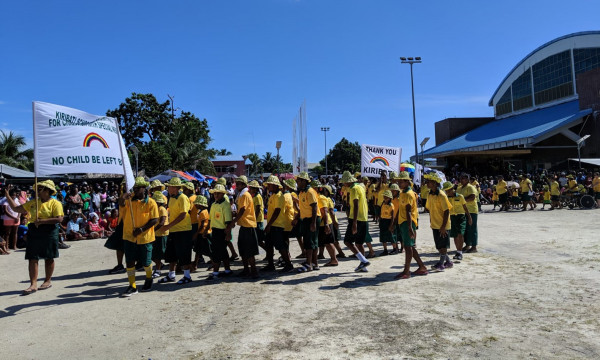
“We had a wonderful experience…our school marched on the parade ground after the military, along with various secondary schools,” Jenny said.
“And our school marched in front of the president, with all the staff dressed in the same uniform as students.
“The students who were vision impaired had a bamboo instrument that played one tone, sort of like a rattle, so they were playing and singing ‘Oh when the saints go marching’.”
Jenny said while most people were expected to take off their hats, face the president and salute, once they reached him the KSCCSN students stood before him and played.
“And he stood, he gave them a standing ovation, in front of all the Kiribati people, all of the dignitaries…they stood too,” Jenny said.
“That gave our staff such a boost, they were not only recognised, but recognised by their president.”
The school’s symbol was a rainbow, the motto was ‘let no child be left behind’, something both Jenny and Tony said staff worked hard to deliver on.
“I can say I was a bit nervous about going to teach or be part of the staff in a special school, because I hadn’t done that before,” Jenny said.
“But, when I got there I realised staff focussed on ability and individual learning plans, they may not have been written, but every child was treated as a special child, with abilities, and they were pushed to the next level, whatever that was.
“So we hardly talked about disabilities, it was ‘what can they do next?’, and I loved that part of the school.”
Jenny said the school was so much a home to the students, many who had moved on would still visit, seeking help with math or English.
“When ex-students return to your school because it’s like home, I think it’s a great place,” she said.
Tony and Jenny said the school principal was a capable woman, who loved children but faced a number of challenges due to the changing dynamic of the Kiribati society.
“In Kiribati, there has been a history of meeting houses, called maneabe, where the men make all the decisions,” Jenny said.
“The women are allowed in the meeting, but seated three rows back, so in the centre was older men, the elders, then the young men, and then the women.
“But now, women like the principal, who has come up and is a head of a school, it is quite hard for her to face the board of governors, that is still fairly male dominated.
“She was fine with Tony, because it’s a totally different culture, but things are yet to be worked out in their culture as they go further into the 21st century.”
Jenny said work formed a “big and very positive part” of their time there, but was still only part of the experience.
Among the challenges were the heat and humidity, a hamstring injury (Tony), crowding and lack of open space.
Life in Kiribati required an adjustment, with simple luxuries available at home in the Mallee suddenly a scarce resource.
“We ate with the students, so it wasn’t that we weren’t well-nourished, it’s just that it wasn’t freely available, so that was a challenge,” Jenny said.
“I also found the rubbish a challenge, and it’s hard to say because they were trying to do things about it, but they haven’t had years of education about sorting biodegradable from non-biodegradable.
“There was a wonderful volunteer who had developed a system of rubbish collection, but for every problem I will say there was someone trying to work on it.
“And, being such a beautiful place, and not being able to swim because of the pollution, that was tough, because it looked gorgeous.”
Even tasks as simple as the weekly shopping suddenly proved a challenge.
“You have to adapt your lifestyle, shopping there wasn’t like here, where we tend to go to the same shopping market all the time and know we can get what we want,” Tony said.
“There are lots of little supermarkets along the long, thin island, and we were fortunate, we had bought one of the volunteer’s car, we could just call into a store and go ‘oh, they haven’t got shampoo today, or fly spray, we’ll try the next one.”
Jenny added bananas became a stop and buy item.
“The first time it was ‘oh, we’ll buy some when they get back’, and they were gone,” Tony said.
“So you know it became ‘oh pull in and buy two lots because you know your friend will want some’.”
Jenny said the other side of the challenges were the “unexpected, wonderful things” about life on the island.
“The Kiribati people are not only happy, but they are welcoming and happy and we were encouraged to be part of their life,” Jenny said.
“The end of first term the staff were going to dance, and they said would you learn to dance? And you should see them dance, they’re incredible, just beautiful dancers.
“So they dressed me in the uniform, put make up on me, until I was just like them, except I was nothing like them, with their fluid hips.”
Jenny also accepted an invitation to learn a traditional dance, which she performed on her farewell.
“They said it will be your gift to the students and so they dressed me in traditional clothes, almost as if I was a bride or something…and three ladies started to sing,” she said.
“But the students knew the song, so they sang as I danced, I never dreamt that was something I would be a part of.”
Tony and Jenny said once their seven months came to an end, it felt “time to come home”, with a new grandson awaiting them in the Mallee.
With their volunteering careers drawing to an end, both Tony and Jenny said their drive to travel to these places and offer their skills, came in part from their faith, but also from viewing themselves as world citizens.
“We had a real world view because we had both travelled at a young age and had seen things and we wanted to do something to give back to developing countries,” Tony said.
“And we know there is a need here too, but people who can’t go away, who have ties here can fill those needs, and we are very involved in the local community, we do what we can to give back here as well,” Jenny said.