Peter Bannan
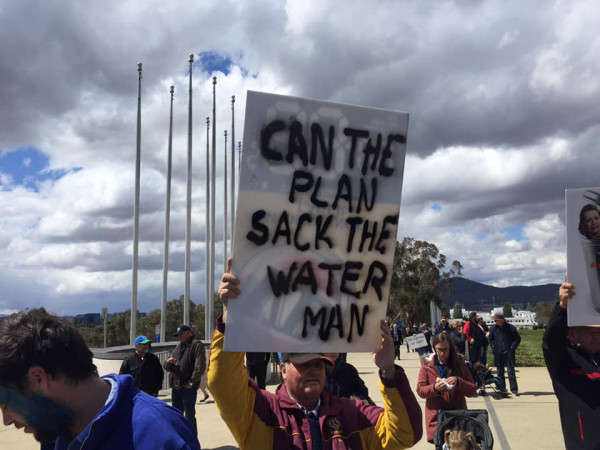
MALLEE farmers were among thousands to join the Convoy to Canberra on Monday and Tuesday, demanding a seat at the table, drawing a line in the sand and demanding action to either fix or can the Murray-Darling Basin Plan.
It was an effort that paid off, with a commitment from Minister for Water Resources David Littleproud to have interim inspector-general Mick Keelty investigate the Murray-Darling basin agreement.
Emerging from negotiations with Mr Littleproud and Mr Keelty, rally delegation representatives Barham farmer Darcy Hare and Barooga farmer and Southern Riverina Irrigators chair Chris Brooks, told farmers while full details were yet to come, they had good news.
“You people in the southern connected system, and I’m not splitting hairs between Murrumbidgee, Murray and Goulburn, we have got a drink,” Mr Brooks said.
“We’re going to get a drink, it may take a few months, and the deadline is March 31, so you can sow a crop next year knowing you can bring the bastard home.”
A statement later issued by the campaign group behind the rally, Speak up, provided more detail on the outcome.
According to the statement, Mr Littleproud will seek an agreement from the Murray-Darling Basin Ministerial Council on December 17 to provide appropriate powers to interim-inspector general Murray-Darling Basin Water Resources (IIG) to “immediately investigate the impact of the changing distribution of inflows to the southern basin on state shares under the Murray-Darling basin agreement”.
“The investigation will also consider any consequential impacts on state share resulting from reserves required under the agreement including how these interact with state allocation policies,” the statement read.
The IIG will report back to the minister by March 31, 2020, with the minister to seek additional resources from Prime Minister Scott Morrison to support the IIG investigation, if required.
Mr Brooks addressed the crowd about 9am yesterday morning, followed by the deputy prime minister.
He said Mr Keelty would be given the power necessary to cut across state and federal law.
“They gave us an undertaking they would have that investigation and report filed by the end of March, which will give us a result — knowing if you have a future, what the volume of water will be, what the new water sharing plans will look like, if we sow a crop next year,” he said.
Mr Brooks said the delegation was “very happy with the result”, and said he expected the investigation to reveal there was “a lot of hard work to do”.
“It was a line in the sand yesterday, it all came about because of the massive numbers of support, of the thousands of people who made the effort to come up here and we got to the table,” he said.
“We have drawn a line in the sand and we are looking forward to working with these people going forward and getting something positive for you blokes to go back and have a life.
“To get your fair share of water and when there’s none there, there’s none there, of course we all understand that.
“But when it is 50 and 80 per cent capacity and it’s running past us at a flood level and you have zero, that’s just a bit hard to take, and that won’t be like that going forward.”
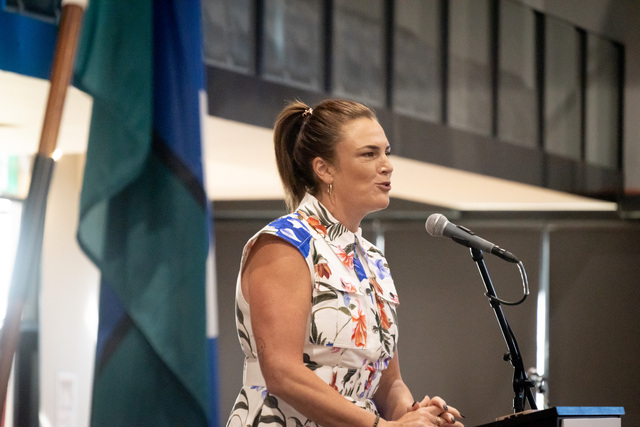
Speak Up campaign chair and co-organiser of the Convoy to Canberra rally, Shelley Scoullar also addressed the crowd.
Before the rally, she had described the basin plan as having “failed on every level”.
“Just to dumb it down, because everyone is sick of another review and another report, but what makes this one different is they are going to look into the Murray-Darling agreement, which hasn’t been done before,” she said.
“There is no way that any of us want to stand up here and give anyone false hope, but we need to continually hold our politicians to account, and this comes back on the states as well.
“They need to sign off at the ministerial council in December, so we have a bit of a wait, but we need to keep that pressure up, to get into the water sharing plans, to get into the Murray-Darling agreement and how that interacts with the Murray-Darling Basin Plan.
“That is a massive step forward and it is a signal to us that maybe it is time we all start working together.”
Deputy Prime Minister Michael McCormack also addressed the crowd, although faced by angry protesters who shouted down parts of his speech when he raised the drought as an issue.
“I appreciate you’re angry, I get the fact you’re hurt, I also get the fact that you are farmers, you are hard workers, you are fathers and mothers and grandmothers sent out to do a job and that was to grow the food and fibre for this nation and many others,” Mr McCormack said.
“And for that, this nation owes you a debt of gratitude, it does.”
Mr McCormack said the protest had swung public opinion in support of the farmers.
“Let me tell you that Damien (Drum) is very much right when he says the Menindee fish kill was blamed on what farmers were doing to the system and I went out and I faced that Menindee community and they were very, very angry, they blamed the farmers,” he said.
“They blamed the politicians, they blamed everyone, it is dry.
“And I appreciate that we are in one of the worst droughts that we have very known, I also appreciate the fact as Chris has just said, he had a good meeting, a productive meeting with the Minister for Water Resources yesterday and that we’re working towards getting a better outcome with the states and we have to work with the states, federal parliament can’t do this thing on our own.”
Mr McCormack admitted all governments had to “do better” when it comes to water management.
“Now when it is dry, yes we need to do better, we need to do better to make sure that the water sharing plans are actually intrinsic with what states do, so you can do what you do and grow more food,” he said.
He also noted not everybody would be happy with the outcome.
“I appreciate you will go away from here still feeling angry, still feeling hurt, and still feeling that — well I do hope you don’t go away feeling ignored because you haven’t been,” he said.
“Mick Keelty has been appointed as an interim auditor inspector-general, he will inspect the plan, he will work with the states, he will work with us and he will work with you to make sure the water sharing plans are better, and certainly, we hope it rains…let’s try and make the states work within the plan, with their water sharing plans, to make it more flexible.”